
Quick summary:
All it takes to rock the relationship between Elena (Margherita Mazzucco) and Pietro (Matteo Cecchi) is a surprise appearance by Nino Sarratore (Francesco Serpico), who makes a vague comment about sex that leaves her reeling for the rest of the season. Aside from obsessing over Nino, Elena spends the rest of the episode promoting her book, crumbling over every bad review, fending off sexual assault, and enraging her mother by setting boundaries. While in Milan for a speaking event at the university, she gets sucked into a protest led by none other than her ex-boyfriend, Franco Mari (Bruno Orlando), and Pietro's sister, Mariarosa (Giulia Mazzarino). Later that night, at Mariarosa's fabulous bohemian apartment, Elena talks to Silvia (Maria Vittoria Dallasta), a beautiful young mother, and learns that her baby, Mirko, is yet another of Nino's unceremoniously abandoned offspring. Will this change her opinion of him? Of course not.
Corresponding book chapters:
"Indecencies" covers Chapters 2-20. As with the S2 opener, the framing differs from the book, and everything that happens in the first chapter is, to my memory, largely omitted from the series. I understand that time constraints led to the minimization of ancillary characters, but my girl Gigliola deserved better.
Notable choice (complimentary):
This is the first season of "My Brilliant Friend" directed by Daniele Luchetti and overall, he does a commendable job. His style is much looser than Saverio Costanzo's, with more handheld camera, which suits the turbulent political climate of the late 1960s through mid-1970s. Combined with the sets and the meticulous, controlled blocking, S1-2 can often feel quite theatrical, but S3 features more real locations that lend an improvisational air to the adaptation. I would have preferred Alice Rohrwacher, who directs the Ischia episodes in S2, as Costanzo's S3 successor, but she was probably already in pre-production for "La Chimera" (2023). Her approach actually reminds me of Costanzo's, but with a dreamy, surreal tinge (e.g., Nino and Lila's ice cream shop makeout scene), and I would have loved to see her take on Elena's growing domestic discontent.
In this episode, the main difference I noticed under Luchetti is the lighting. There are several scenes where it's used, along with color grading, to underscore emotional beats. As Elena composes herself in the restaurant bathroom after her novel presentation, the scene is overwhelmingly green. The room is lit by two sconces on either side of the sink that dimly reflect off the white marble and mirrored surfaces. The light adds to the uneasiness of watching Elena spiral over Nino for the umpteenth time. Before leaving the room, she says, "Enough, I was sick of everything and everyone, even of myself for wasting the evening like that." Back at the hotel after dinner, she's in another eerily green-lit hallway when Tarratano (Maurizio Tabani), the old critic from the book event, assaults her. Safely back in her room's private bathroom, she's bathed in blue as she cries over how meaningless life feels without Nino. Following her first bad review, she tosses and turns in a blue-lit bed, worrying about what Lila might think of her book.
Even though things are going relatively well for Elena at this point, the lighting creates a sense of unease, and it feels like only a matter of time before something — worries about what other people think of her, an unrelenting obsession with Nino, unwanted advances from disgusting old men — sets her over the edge.
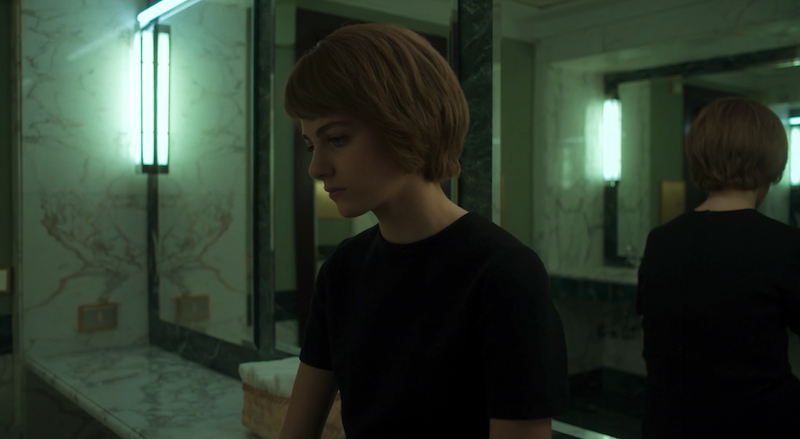
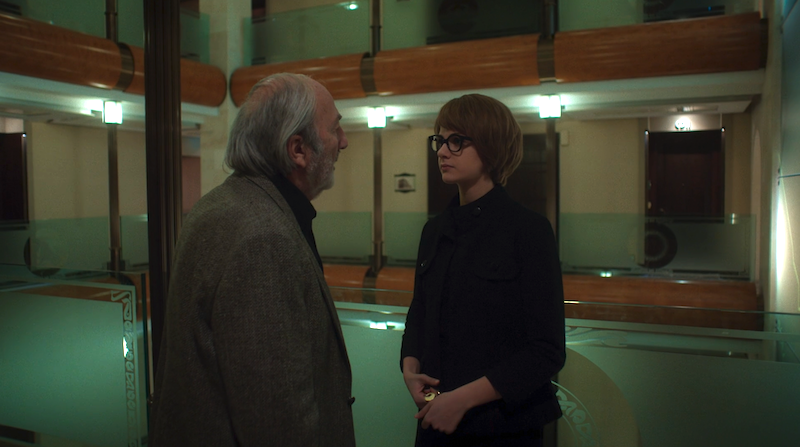
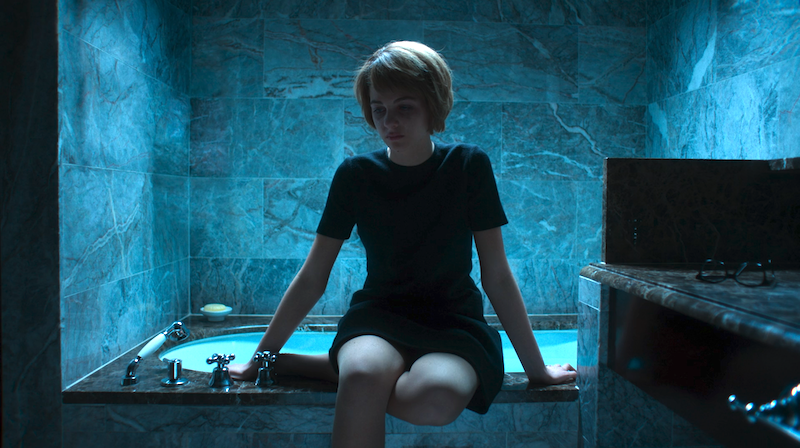
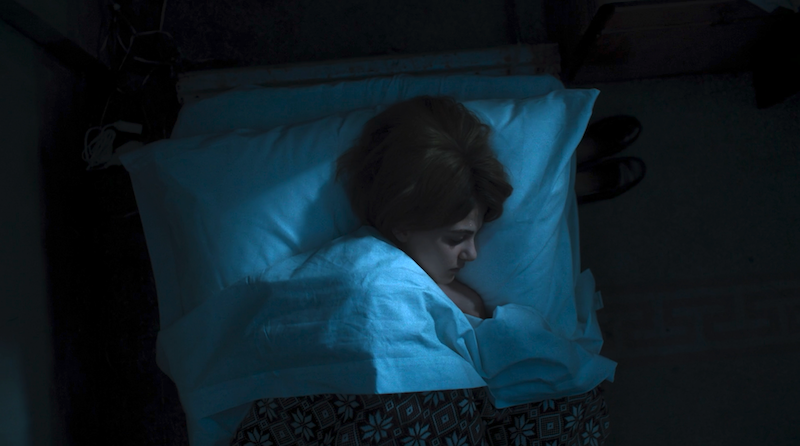
It's horror/thriller movie lighting, which I don't think we've seen much thus far. These could be stills from Steven Soderbergh's "Unsane" (2018).
Notable choice (derogatory):
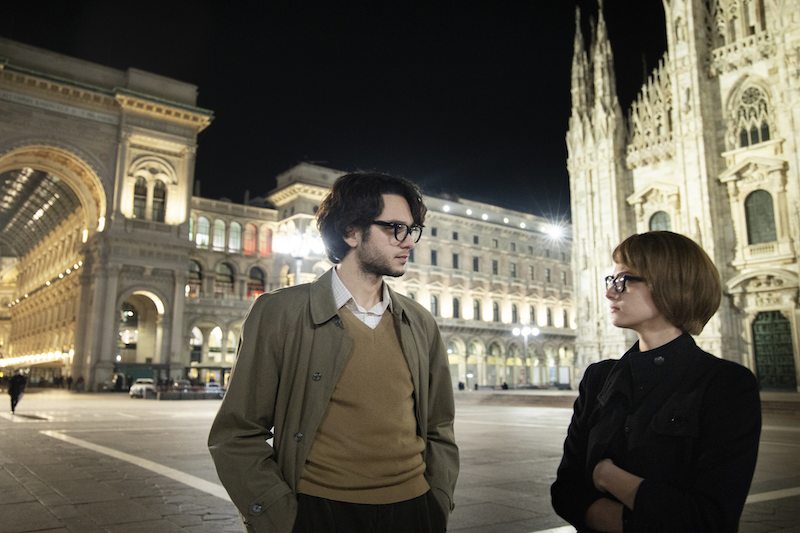
The novel provides significantly more context surrounding the bookstore scene and its aftermath, not only giving a better social/political framework for understanding the heated exchange between Nino and the professor, but also adding essential depth to Elena. In the show, she seems completely lovestruck by Pube Beard, too distracted by his presence to participate in dinner conversation. When she goes into the bathroom after telling everyone she has nothing to say about the newspaper article they're discussing, she muses via voiceover,
By then, I knew [Nino] wasn't attracted to me. In Ischia he chose Lila, not me. And yet I still wanted him, I only wanted him. I would have liked to make him walk all night to ask him: What music should I listen to? What films should I see? What books should I read?
What doesn't come across so well in the show is how ashamed Elena feels after failing to defend herself and how exhausted she is after years of assimilating to different social groups throughout her education only to face the same alienation as a professional adult. Part of what she finds so alluring about Nino is that he's a fellow Neapolitan street rat who doesn't appear to suffer from imposter syndrome and class anxiety in the same way as her. In the novel, she observes,
The very quality of his speech on my behalf had confirmed to me that I had abruptly lost my abilities. We came from backgrounds that were not very different, we had both worked hard to acquire that language. And yet not only had he used it naturally, turning it easily against the speaker, but, at times, when it seemed to him necessary, he had even dared to insert disorder into that polished Italian with a bold nonchalance that rapidly managed to make the professorial tones of the other man sound out of date and perhaps a little ridiculous.
When Elena thinks about asking Nino for recommendations, it's less "burn me a mixtape" and more "help me figure out how to better masquerade as someone who didn't grow up sleeping in the same room as my parents and three siblings." In the show, she comes off as a vapid bitch with a crush, whereas in the book, her infatuation with Nino, while still insufferable, feels like a form of class solidarity. I wrote about this in S2's "The New Name," and it will surely come up many more times before the series has ended.
Thoughts:
How much evidence does Elena need before she finally writes Nino off as an unforgivable piece of shit? First, he ghosts Lila, when she is, for all he knows, pregnant with his child. Maybe he convinced himself the baby is Stefano's, that he has to stay away or suffer the wrath of the mob... there are weak excuses for his behavior that I don't buy, but let's suspend disbelief. What are the chances that the rejection of his second (that we know of) child is also justified? How will Elena dismiss his dirtbag actions this time? Prepare yourself for disappointment because her rationale in the upcoming episode is bleak.
As previously discussed, I find book Elena equally infuriating to tv Elena, just harder to dismiss since her Nino yearning is more obviously a projection of her fantasy self onto a similarly positioned person. She wants to be the one who tells "old man yells at cloud" he's out of touch with the culture, not the silent, unsophisticated people pleaser. She wants to be the experienced one who knows what it means to be "made badly when it comes to sex." She can't see that Nino is an asshole who did a fucked up thing — first to Lila, then Silvia — and instead of taking accountability, blames the wronged party. His comment has nothing to do with Elena, who, before she aligned herself with the Airotas, probably never once crossed Nino's mind.
Surprisingly, Elena doesn't seem worried about how Adele (Daria Deflorian), her future mother-in-law, interprets her relationship with Nino. As she signs books outside the shop, she can't stop looking at him, admitting via voiceover, "I trembled at the idea that he would leave." In the book, she even tries to skirt Adele's celebratory dinner to spend more time with him before being informed he's of course invited. Perhaps Elena is already aware of Adele's egocentrism, knowing she would never anticipate a poor girl from the south risking upward class mobility to get railed by a nobody like Nino. To Adele, and Pietro, the surprise guest at dinner, Nino is Elena's charming, non-threatening childhood friend who also managed to pull himself out of poverty and into a life of intellectualism. He's not, for example, a young tenured professor like Pietro who comes from a pedigreed family, so why would they suspect anything untoward? They're all high off the prestige of the Airota name, which, as Nino says, is synonymous with "a family of great traditions, among the most civilized of those that count in Italy."
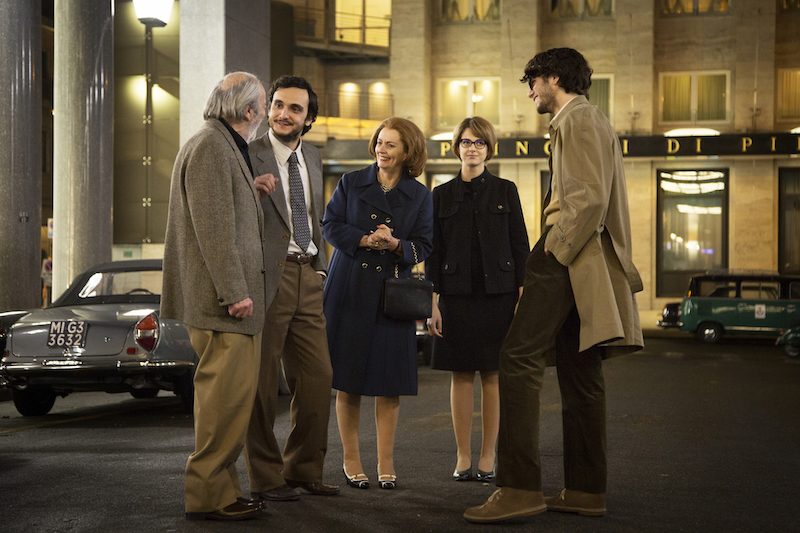
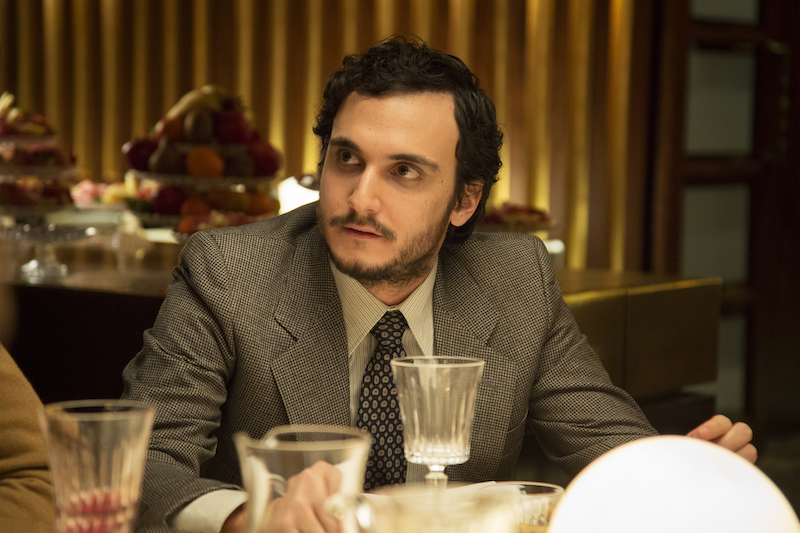
My favorite moment at dinner is when Pietro, after being practically forced by Adele, makes his tenure announcement and we get to watch in real time as Nino's charismatic, deferential facade drops. This moment is described briefly in the book, but Luchetti fleshes it out so that we see Elena glance at Nino, aware on some level of how he might be feeling. Eventually, he breaks his silence with a remark that sounds poised to start a fight before dovetailing into strained congratulations. Elena doesn't spend any time, in either the book or the show, reflecting on Nino's obvious disappointment. In the book, she clocks his "acerbic remarks on university careers" without going any further. If she stopped thinking about herself for one second, maybe she would realize that Nino isn't as confident and capable as he seems. He, too, faces challenges because of his background and isn't some mythical creature who handles every interaction flawlessly. This absolutely does not justify any of his behavior, but it's notable that, similar to Elena, his own class anxiety contributes to his biggest character flaws.
Adele's comments in the tenure scene, which aren't in the book, are likewise revealing and provide subtle foreshadowing for the kind of life Elena will have as Pietro's wife. Reacting to the tenure news, Elena says, "Just like that, as if by magic. I never know what he's studying" and Adele responds, "Elena, it's much better like this. We women are given the task of being happy about their success." As a contrast, imagine Enzo and Lila, who are absent from this episode, studying together through the wee hours of the night, true partners in a collective endeavor. Pietro doesn't seem to want that type of relationship. Instead, he does his thing, Elena does hers, and there's only tangential involvement from either direction.
My read on Pietro, which may change as I move through S3, is that he's not a bad person, just a bad match for Elena. She's an internalizer and he doesn't have the time, patience, or ability to read between the lines to figure out what's going on when she's being evasive. During their walk to her hotel, she lashes out in nonsensical ways, telling Pietro she hates Florence (the place where they'll live/he'll teach) and no longer wants to be a writer. He has no idea what's happening or how to deal with it and is basically just like, "Ok, do what you want," and then asks to stay in her hotel room. Not even Elena can fault him for this, and while she turns down his request, she's more certain than ever about marrying him. In the book, she calls out his "conspicuous sense of duty" that ensures he would never leave her, along with his ability to help erase the coarseness of her upbringing. She believes Nino would make her feel seen and that he'd be a good fuck, but he's unreliable and his dad's a rapist. For anyone with half a brain cell, the decision is moot.
The rest of the episode revolves around the response to Elena's book — from critics, the neighborhood, Franco Mari — but there is one significant scene with her mother (Anna Rita Vitolo), who feels the need to knock Elena down a few pegs lest she think too highly of herself. As Elena sits in a chair, lazily smoking a cigarette with her feet propped up, her mom gives a classic, "You think you're better than us" speech while smearing jam on bread. Immediately, this visible detachment amidst a slew of abuse feels like growth. Elena doesn't get angry or defend herself, simply throws some money at the problem and grey rocks it to the grave. Even when the situation once again intensifies with news of Elena's city hall wedding, she keeps her responses as neutral and diplomatic as possible, letting her family fight it out while she pleasure reads Horace on the other side of the room. Immacolata can be a real bitch, but "Professor of my ass" is insult poetry.
When Elena reads the first negative review, written by the old grouch from the bookstore, she falls deep into a pit of self-loathing. She cries in the street as the haunting piano score plays, and in the phone booth as the Airota family try talking her down from the ledge. Pietro, of course, doesn't know how to handle her emotions and almost immediately passes the phone over to Adele, who assures her good reviews are to come. Nothing can console her, and, following the scene where her mother calls her selfish and unremarkable, it makes sense that she would take this rejection of her first real artistic pursuit hard. Most of all, Elena worries about whether Lila will read it and what she might think. Her carefully crafted image of a serious scholar and writer is too fragile to exist without the right kind of praise and admiration to prop it up. If Lila thinks it's bad, then it's bad. Full stop.
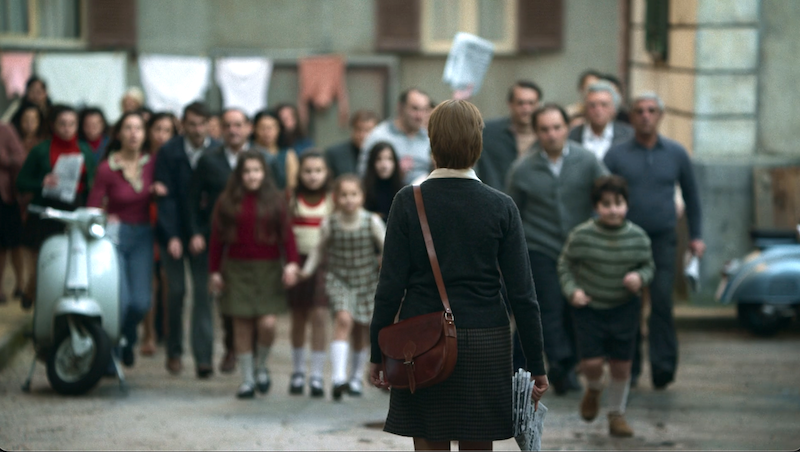
Thankfully, the good reviews start pouring in just like Adele said they would, and Elena manages to use them to counteract the harsh words from crusty male "journalists" (including Donato Sarratore, natch) that probably hate the book for selling so well and don't understand how they're contributing to the hype train. When the neighborhood catches wind of the book's "racy" nature, they all treat it like a memoir and see Elena as a whore. Gino (Riccardo Palmieri), her idiot first boyfriend who's now fascist scum, brazenly compliments her tits. Michele Solara (Alessio Gallo) cajoles her into a coffee, then tries getting her to admit that everything "dirty" in the book came from Lila. Her brothers fight with some boys besmirching her good name. There's a scene where Elena imagines a horde of people running after her in the street, a visual representation of what it feels like to be targeted by a mob of people with no critical thinking skills.
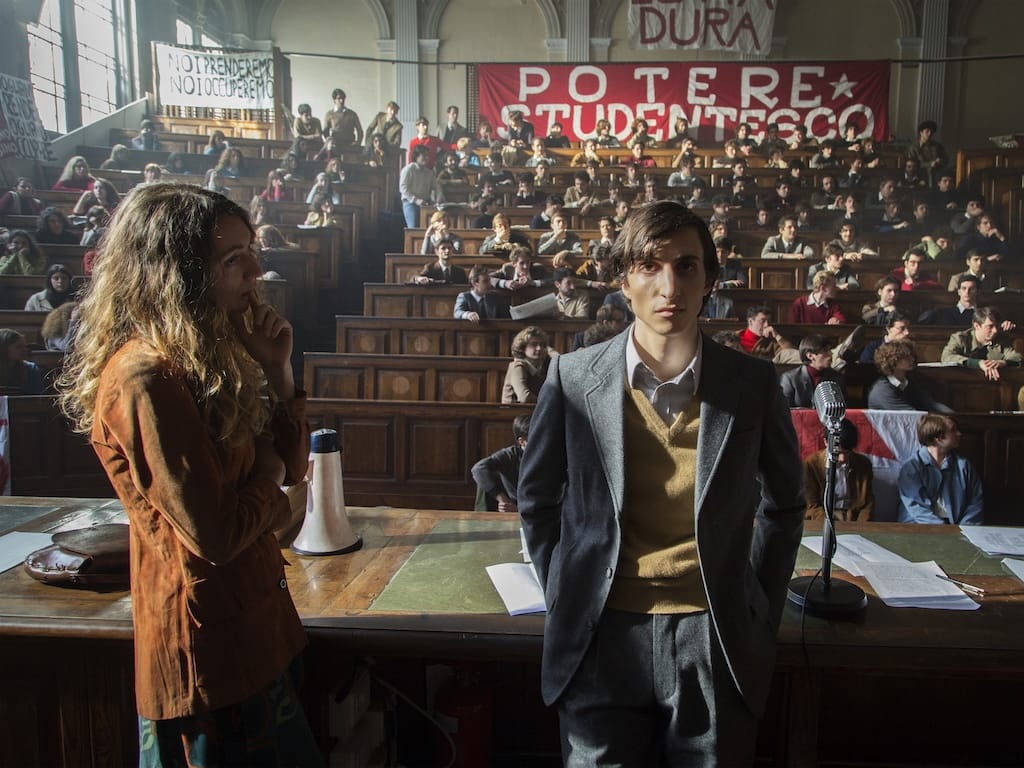
Her lecture at the University of Milan provides the perfect escape from the neighborhood, although the environment is just as chaotic because student protests are underway. After failing to find any details about where to go, Elena finds herself in a large auditorium teeming with chaos. Students mill around, smoking, waving signs, and clapping as Franco and Mariarosa stand at the front behind a long desk. Earlier Elena notes via voiceover that she was "almost glad to discover that no one was expecting me, my book had zero importance. There were bigger things to squabble over."
We don't get a ton of context since voiceover happens over much of the scene, but I agree with the guy who stands up and screams, "The revolution belongs to the proletariat!" Franco speaks from a place of naive privilege when he declares, "We can open the eyes of the workers, the workers' children, yours, everyone's." You know what the workers don't need, Franco? Some rich fuck-up who couldn't even make it through university coming into their factories and giving them orders that will allegedly help improve their lives (which you know absolutely nothing about). I can't be too salty about youthful idealism and political activism (especially since I know Franco's full trajectory), but adult me finds him a little eye-rolly.
Back at Mariarosa's apartment, Franco and Elena have a much nicer time together than they do in the book. For a second, it even looks like they might fuck again for old time's sake until he walks off with Mariarosa. The main takeaway from their interaction is his dismissal of Elena's book, which he lukewarmly praises when prompted before eventually admitting he doesn't believe now is the time for novels. Here's another idiotic Franco comment: "You use tales of romance and social climbing to hide what's worth saying." Umm... have you heard of subtext? Here's yet another man who clearly has never studied Jane Austen and is 10,000x worse because of it. In all fairness, we don't know what Elena's book is like so I can't specifically defend it, but fiction in general certainly has the ability to say powerful things under the guise of fluff. Juan (Eduardo Rejón), the painter, is another man who could use a lesson on the function of fiction. Just because Elena writes about sex doesn't mean she's interested in having it with anyone who propositions her. I like Mariarosa on a surface level, but her association with these scumbags warrants an eyebrow raise.
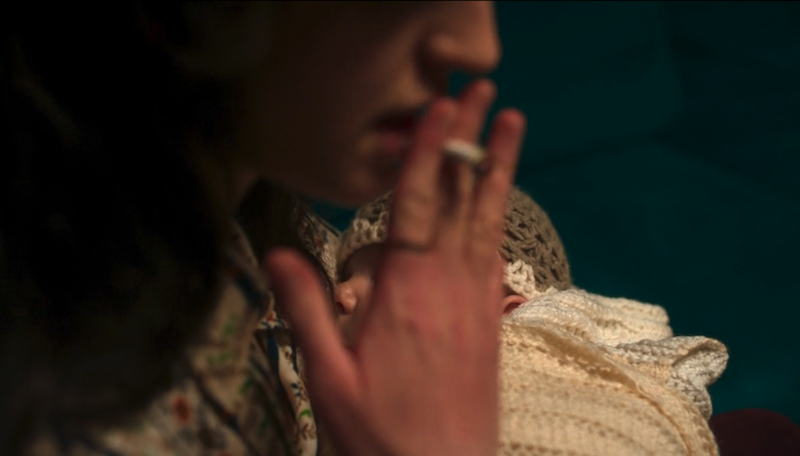
The other noteworthy event at Mariarosa's is Elena's connection with Silvia, who she first spots at the student protest and mentally links with Lila even though the only thing they initially seem to have in common is young motherhood. Elena is simultaneously disturbed and intrigued by her, this girl who seems intent on angrily rejecting placid caregiver stereotypes, often at the expense of her baby. As they spend more time together, Elena helps her with Mirko and finds that she enjoys the experience. In the book, she questions her own maternal desires, worrying about what will happen "if my mother should emerge from my stomach just now when I think I'm safe." The whole experience seems like a warning from the universe about what happens when women ignore their gut impulses by trusting untrustworthy men. Hearing Silvia utter the name "Nino Sarratore" should be enough to repulse Elena for the rest of her life, and yet... sometimes the only way people learn is by suffering through their own poor decisions.
Random observations:
- Mariarosa has no problem telling her dad his opinions are shit, yet she remains silent when the men her age, who she'd like to fuck, spout off nonsense desperately warranting a rebuttal. Blessed youth!
- Did you spot Elena kissing two men who aren't Pietro in the new opening credits?
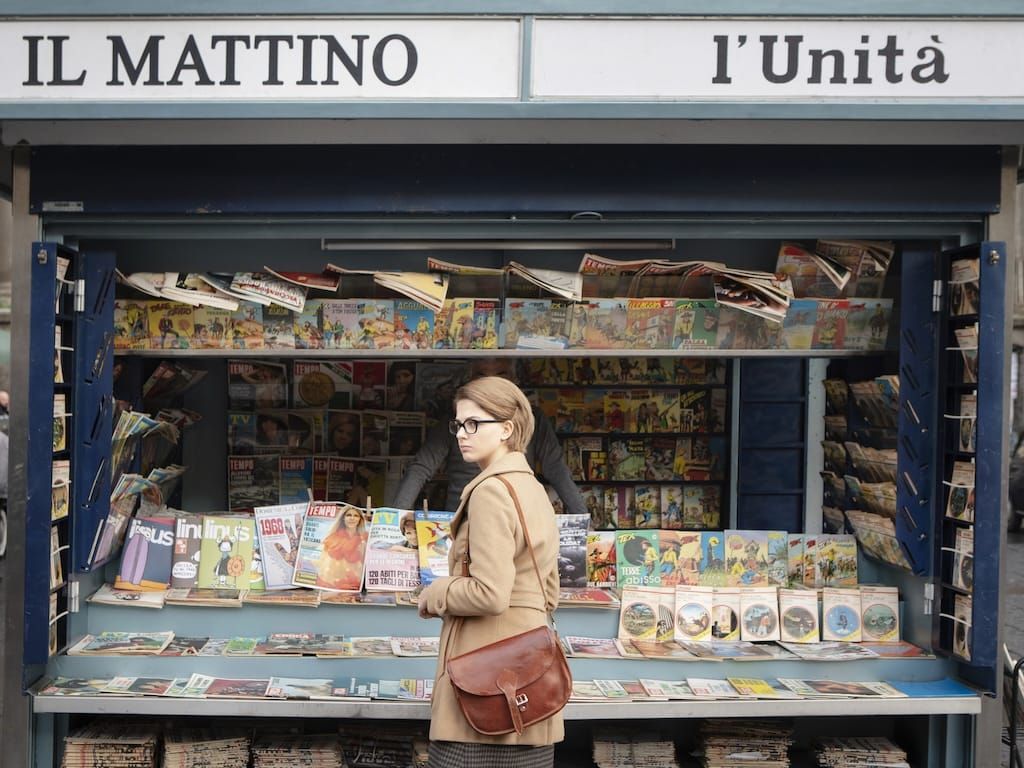
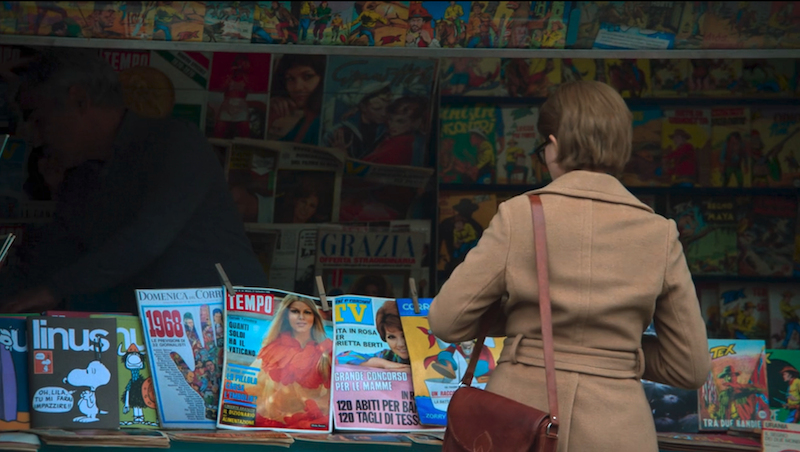
- Posters hanging in the Naples bookstore: Cervantes, Dickens, Tolstoy, and a bunch of other writers I can't identify. Also, at the newsstand, Linus magazine sent me down this Wikipedia rabbit hole. I can get behind a magazine that publishes comics alongside reader submitted reactions to Elsa Morante's "La Storia" (1974).
- I wonder if Franco still considers Daniel Cohn-Bendit a comrade after his 1975 book, "The Big Madness," which details his pedophilic behavior as a German kindergarten teacher.
- I hate to admit it, but book Nino has a solid point at dinner, which is that underpaid university professors use their positions to get lucrative side gigs that make teaching and research secondary. This is still a problem today that I suspect won't die until capitalism does.
- When book Elena buys Freud's "Three Essays on the Theory of Sexuality" (1905), she says, "I knew almost nothing of Freud and the little I knew irritated me." If I had to put money on it, I'd guess she read something about penis envy.
Member comments