

It's been over one year since I finished S1, so check out those recaps if you need a refresher. From what I recall, S2 is, without a doubt, the series standout. If you finish this season and still aren't invested, it's safe to say the show isn't for you. If you're watching (or reading) for the first time, I'm supremely jealous of the heightened emotions you're about to experience. Just remember: you can't actually throw a molotov cocktail through Nino Sarratore's window because he's a fictional character.
Quick summary:
Lenù is distraught after witnessing Marcello Solara's wedding entrance wearing Lila's shoes. In her mind, Lila, who reappeared at the end of the wedding as if nothing had happened, has overlooked this betrayal because she's madly in love with Stefano. In Amalfi, she'll get fucked for the first time and nothing will ever be the same between the two friends again. Lenù is so in her head over this shifting dynamic, along with Nino's unspoken rejection of her unpublished article, that she nearly drops out of school to marry Antonio, who is barely holding it together in light of impending military service. When Lila returns from her honeymoon with a battered face and resigned hatred for her husband, the warmth between her and Lenù returns.
Corresponding book chapters:
"The New Name" covers Chapters 1-14, although the novel frames the story differently, beginning with 1966 Lila (five years post-wedding) entrusting her journals to Lenù, who promptly reads them, loses her shit over their brilliance, and throws them into the river. These actions are eventually depicted on the show, but not until E7 "The Secret Notebooks." The wedding events also carry over into the early chapters of the novel, whereas the show picks up after they've ended.
Notable choice (complimentary):
The show takes the book's brief, forgettable mention of Lila's "painting of a stormy sea" and uses it to great effect in the apartment scenes, underscoring both girls' emotions. Before it first appears, Lenù has just seen Nino and his girlfriend kissing outside of school. As she gazes at them, her voiceover states, "I never told anyone what I felt in that moment," as her face dissolves into a close-up of the painting. The first glimpse reveals sky with a hint of mountain; as the camera slowly tracks out, we see sailboats strewn across a stormy sea as people in the foreground rush to safety on the rocks. The painting is framed in gold with Lila and Lenù on either side, sitting just below it on a velvet, olive green couch. They're each dealing with internal chaos that could benefit from an outside perspective if only they were willing to be truly vulnerable with each other.
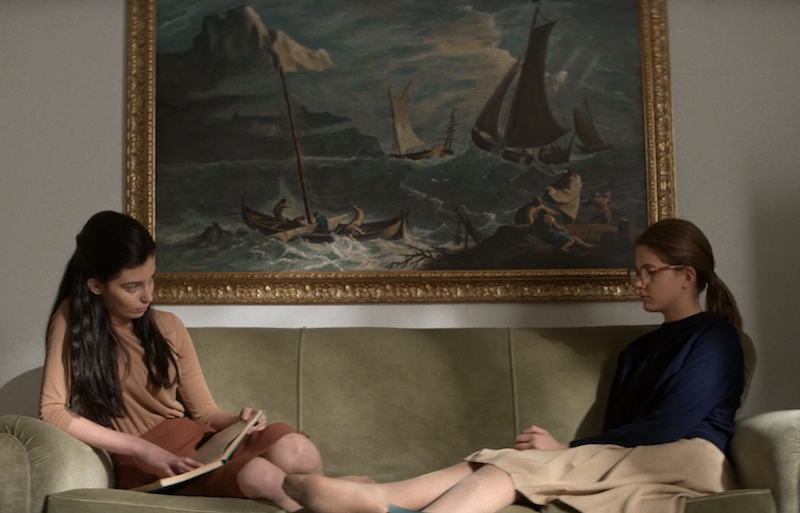
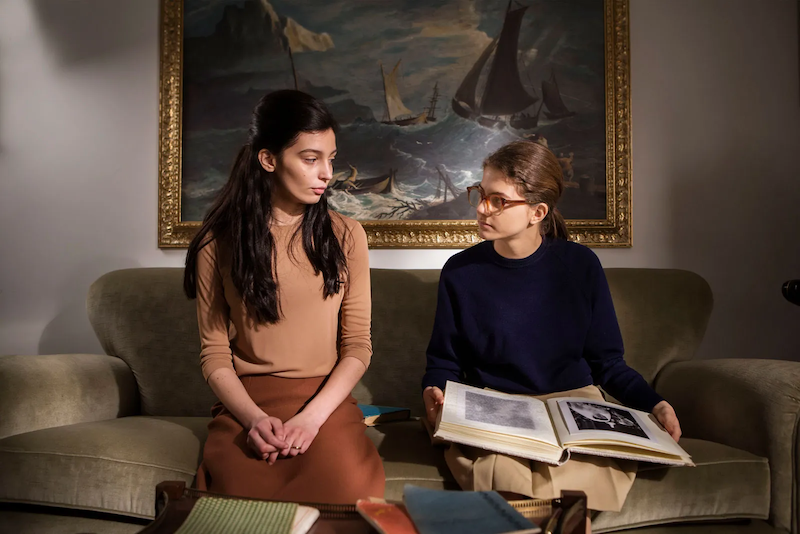
The painting is Marco Ricci's "Fishing Boats in a Storm" (~1715). I'm including two images to show what a difference lens and camera placement make. Left is a screen grab, right is a production still.
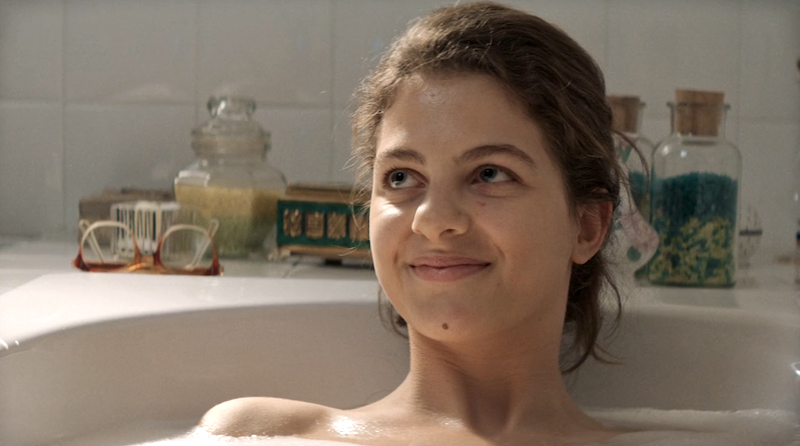
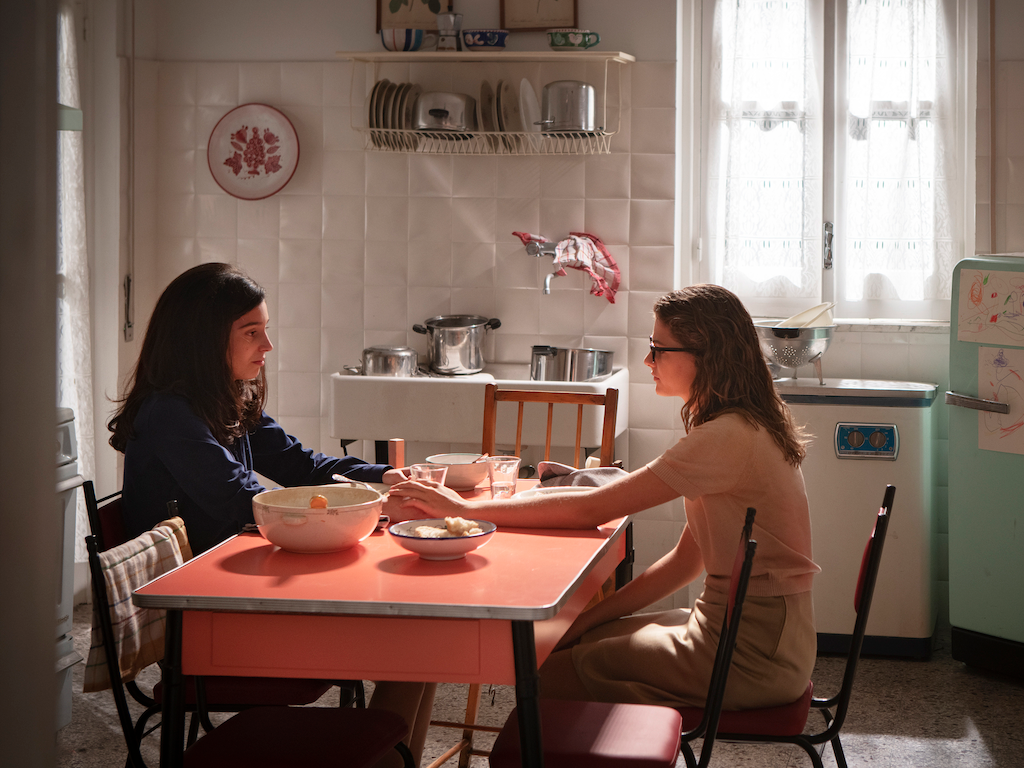
Lenù is consumed by thoughts of Nino, yet unwilling to share them. When Lila asks if she likes him, she swiftly denies it. Lila, despite her house full of finery, is more isolated than ever before. Later, as Lenù takes a luxurious bubble bath in the apartment, her voiceover muses on Lila's loneliness: "The condition of wife had sealed her in a glass container, like a boat navigating with sails unfurled in an inaccessible space, even without any sea." This dialogue comes directly from the text, but it feels more impactful onscreen, having just stared at a visual representation of it in the previous scene. The girls are still floating on separate ships, alone with their repressed worries and desires, when they should be helping each other onto the rocks.
Notable choice (derogatory):
Nino's appeal — and Elena's obsession with gaining his approval — is more obvious in the book. Thanks to the article Nino asked her to write and then neglected to publish due to bullshit space issues, she spends most of Chapters 1-14 trapped in a pit of self-loathing. In Chapter 9, she thinks to herself,
Even though Nino was born and had grown up like Lila and me in that wretched outlying neighborhood, he was able to use school with intelligence, I was not. So stop deluding myself, stop striving. Accept your lot, as Carmela, Ada, Gigliola, and, in her way, Lila herself have long since done.
Later, when Elena and Lila watch the wedding video (a scene likewise absent from the episode), she fixates on a moment when the Solaras enter the reception and Nino slips out, inadvertently bumping Marcello, who turns around with a menacing look. Elena determines,
In that sequence Sarratore's son [...] now appeared completely outside the scale of values at whose peak stood the Solaras. It was a hierarchy that visibly did not interest him, that perhaps he no longer understood.
To Elena, Nino represents proof that it's possible to move so far past one's shitty origins that all the petty slights and power struggles from that place/time completely disappear. If Nino respects her, chooses her, it must mean that she, too, has found a way to transcend her upbringing and all the insecurities that go with it. The show omits Nino's relationship (or lack thereof) with the neighborhood in this episode, so Elena's infatuation with him lacks subtlety.
Thoughts:
The S1 finale ended with a dark pall hanging over the wedding that only Lila and Elena could see. Once Marcello waltzed in wearing the shoes, any possibility of marital happiness was swiftly eradicated. As with middle school, Lila let herself believe something good was on the horizon only to have her hopes dashed by harsh reality. Elena is the one with a legitimate escape route to a new life, only she can't appreciate it because she's too consumed with comparisons to Lila and crippling self-doubt.
No matter how dire Lila's situation might look, it doesn't take long for Elena to flip it around to make herself the victim. In the novel, she goes from thinking Lila's marriage is over to believing it's a love so great that a trash person like her couldn't possibly understand it. No matter the state of her relationship with Lila (early S4 aside), Elena always finds a way to convince herself there's a great distance between them that she must strive to close.
Before Lila returns from her honeymoon, Elena spends most of her time spiraling, making idiotic decisions that threaten her academic standings. The night of the wedding, she decides to fuck Antonio so she and Lila can lose their virginities together. To his credit, Antonio stops her, stating he wants them to be married before they have sex. This might seem puritanical in 2026, but in pre-contraceptives Italy when even the best men make death threats, hand stuff is preferable to unwanted pregnancy. I don't often agree with Immacolata's parenting tactics, but I, too, would have (verbally) slapped the shit out of Elena for blatantly lying and threatening to derail her comparatively cushy life for someone she doesn't even love.
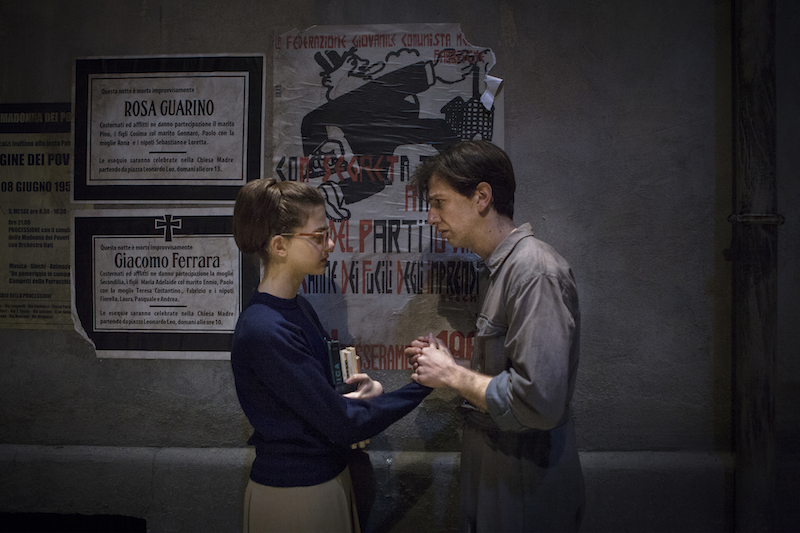
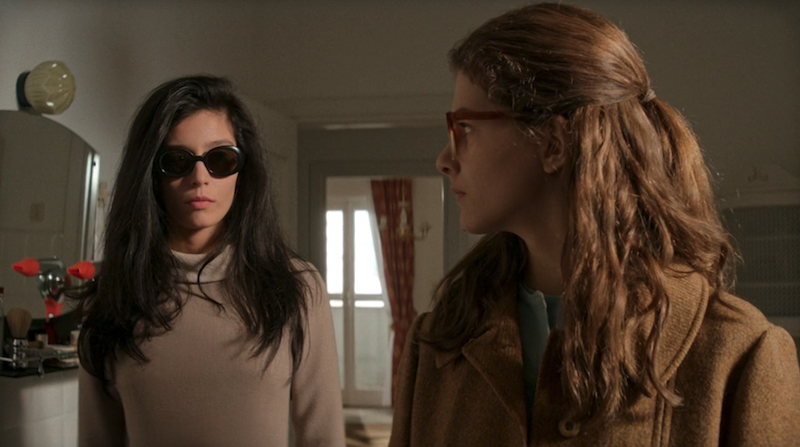
As part of her destructive "What you do, I do" streak, Elena also stops attending classes, spending her days wandering around Naples as Nino's rejection echoes in her head. This all changes when Lila returns home from her honeymoon and Elena finds her ensconced in a fancy new apartment, hiding a black eye behind a dark pair of sunglasses. The reveal happens differently in the show, presumably to compress time with the apartment tour, although I find the impact comparable to the book.
When Elena arrives outside Lila's door, her own visage reflected back in the shiny gold "Carracci" nameplate, it's easy to imagine her mounting anxiety over how the friendship has shifted. Why would Lila, the Neapolitan Jackie Kennedy, pal around with an inexperienced school girl? Because, contrary to Elena's inner saboteur, Lila's time in Amalfi was far from fabulous. Instead of swanning around a luxurious hotel room in wedded bliss, she was beaten and raped.
Saverio Costanzo's direction in the honeymoon recollection scenes helps communicate Lila's unspoken mental state. Even before Elena takes off Lila's sunglasses to expose the black eye, the scene's blocking highlights her evasiveness. Lila is often isolated in the foreground as she showcases each feature of the apartment; when Elena walks up to her, she turns away, leaving her friend alone in the frame, looking back at her. Lila is aloof because of shame, not a sense of superiority. If she keeps moving, steering the conversation toward telephones and bidets, maybe Elena won't notice something is wrong and she can avoid addressing her sham marriage.
In the Amalfi scenes, which present as immersive flashbacks, Lila is similarly avoidant. The action plays out much as it does in the books: Lila confronts Stefano, he slaps her when she won't relent, then acts like everything is normal at the hotel and doesn't understand why she's disgusted by his boner. During their interactions leading up to the assault, Lila is always more prominently positioned in the frame even when she's not speaking. When she and Stefano are in a two-shot, she's closer to the camera, taking up more visual space. Even when the shot is wider and she's relegated to the background, she pulls focus by facing the camera while Stefano's back is turned. It's impossible to ignore her powerlessness because Costanzo constantly centers it. After the initial slap in the car, it's a long, tense waiting game for further escalation.
There are a few interesting POV shots in the hotel room, like when Lila gazes at something unseen that, a few beats later, is confirmed as the bed. After dinner, in the bathroom, there's a closeup of Lila's hands, wedding ring on her finger, before we see her pensively looking down at them. The show does just enough to make us wonder whose version of events we're experiencing. There is no voiceover for Lila, so we don't actually know what she tells Elena. Is this older writer Elena's memory of what Lila told her or something else? In the book, we know these details are "not only as she told it to me [...] but as I read it later, in her notebooks." Not introducing the journals into the show until the end of the season sets up a dramatic reveal, but it also changes the viewer's perception of who is telling the story. I want to pay close attention to this throughout the rest of the season, especially when the journals finally appear in "The Secret Notebooks."
The show makes many other effective choices, including the addition of a little girl who Lila makes eye contact with while checking into the hotel. At first, she's all alone and looks forlorn. She probably envies Lila, a proper lady in a chic periwinkle skirt suit with a handsome man by her side. Later, when Lila sees her again at the hotel restaurant, she's smiling and laughing with her parents. This little girl, surrounded by love and support, is the enviable one. Unlike the Cerullos, her parents probably wouldn't marry her off to a monster to improve their own financial standings. From a very young age, Lila has always been alone without anyone to rely on but herself. Now that she's married, nothing has changed. The later scene, where she makes a bruised appearance at Pinuccia and Rino's engagement party and no one gives a shit, reinforces how poorly anyone looks after her.
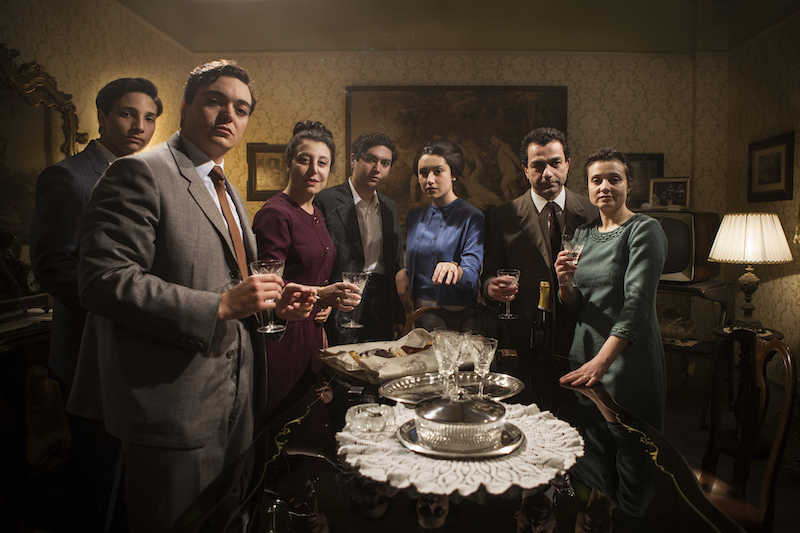
Is Lila's misfortune what finally convinces Elena to return to school? It's less explicit in the show, but it's played like some combination of this and Nino's renewed interest in her. In the book, she's motivated by something vague that Alfo says, which she interprets as an admission of her influence over him. For someone with low self-esteem, sometimes the biggest motivating factor is a compliment or expressed desire from someone else. I've written about it before, but book Elena is much more of an asshole than TV Elena. Case in point, this is what the former thinks after Lila's honeymoon story:
I have to admit, I also felt a tenuous pleasure. I was content to discover that Lila now needed help, maybe protection, and that admission of fragility not toward the neighborhood but toward me moved me.
Elena wants to be needed, wanted, useful. By going back to school, she fulfills the role Lila had assigned to her: "the friend with glasses and pimples, always bent over her books." Lila has a guest room where she wants Elena to come study; Alfo needs her guidance to improve his opinion of women; Antonio needs someone to help him avoid the draft. So, Elena returns to school, and the episode ends with her and Lila preparing to ask the Solaras for help on Antonio's behalf. In a self-destructive streak of her own, Lila has decided that if Stefano can get involved with them, so can she. After learning the Solaras were responsible for Stefano's own dodged military service, Lila realizes her husband was in bed with them eons before the shoe business. She was lied to from the jump, and now it's time to put on some red lipstick and go seek revenge.

Random observations:
- The dynamic between Elena, Antonio, and Nino at the wedding reminds me of Rory, Dean, and Jess. Antonio has accurately assessed Elena's romantic interest in Nino, but he's so desperate to be with her that he'll succumb to her bullshit for as long as his ego allows.
- Who do you identify with most in this episode? For me, it's the black cat sleeping on a wall as Antonio and Lenù dry hump.
- Who would you rather watch eating shrimp, Stefano Carracci or Harvey (Dennis Quaid) in "The Substance"?
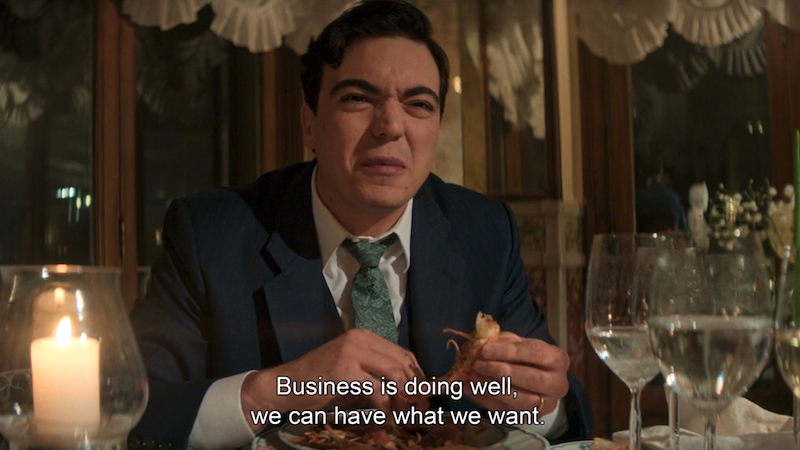
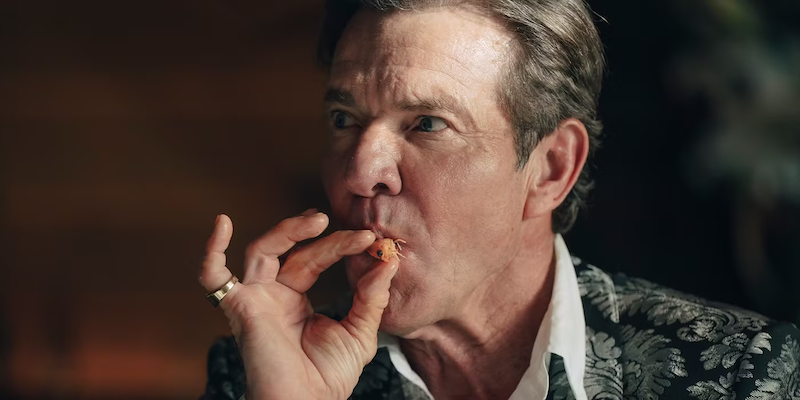
Both of these men deserve a seafood fork to the throat.
- Queer foreshadowing: Alfonso gets distracted by a cutie rolling a cigarette at the back of the bus while talking to Lenù.
- As Elena reads Nino's essay in class and marvels at its brilliance, Professor Galiani discusses Petrarch and his muse, Laura, a woman he obsessed over from a distance. There are obvious parallels to Nino, who Elena views more as an ideal than a real person. Her muse, Lila, is more fully formed; while Elena certainly projects things onto her and massages details to suit her own needs (what author doesn't), she writes about Lila with a curiosity and an intellectual rigor that Nino ever receives.
- I'm not ashamed to admit I'd be taking a bath at the Carraccis' every damn day.
Member comments