
Sorry for disappearing last week, but I had nothing interesting to say and no time to say it. I work in ecommerce, so the weeks of Black Friday and Cyber Monday are always busy, especially now that many retailers run sales for almost two months straight. My husband and I also hosted Thanksgiving and the prep really cut into my leisure time. I don't think I watched or read a single thing until the weekend. I did, however, make this buttermilk pie with Claire Saffitz's crust from "Dessert Person," which I highly recommend.
In exciting news, my foster cat had six (!!!) kittens on November 30 and I got to witness the birth. It was very efficient, like watching someone unclog a hairy drain. She handled everything herself, ate all the placentas, and has been purring at a deafening volume ever since. One disgusting thing I didn't know until this experience is that a mother cat consumes her kittens piss and shit until they're three or four weeks old and have control of their faculties. It's done to keep the space clean, avoid attention from predators, help develop the kittens' gut microbiomes, and reabsorb nutrients. The miracle of life, baby.
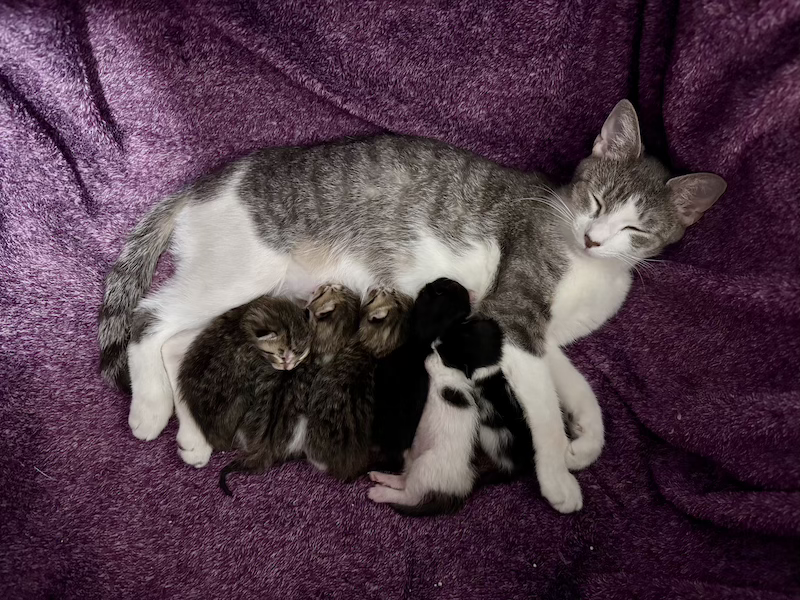
Please send me well wishes as these little idiots get older. We're supposed to have them for at least seven more weeks, which is plenty of time for their true meth head personalities to emerge.
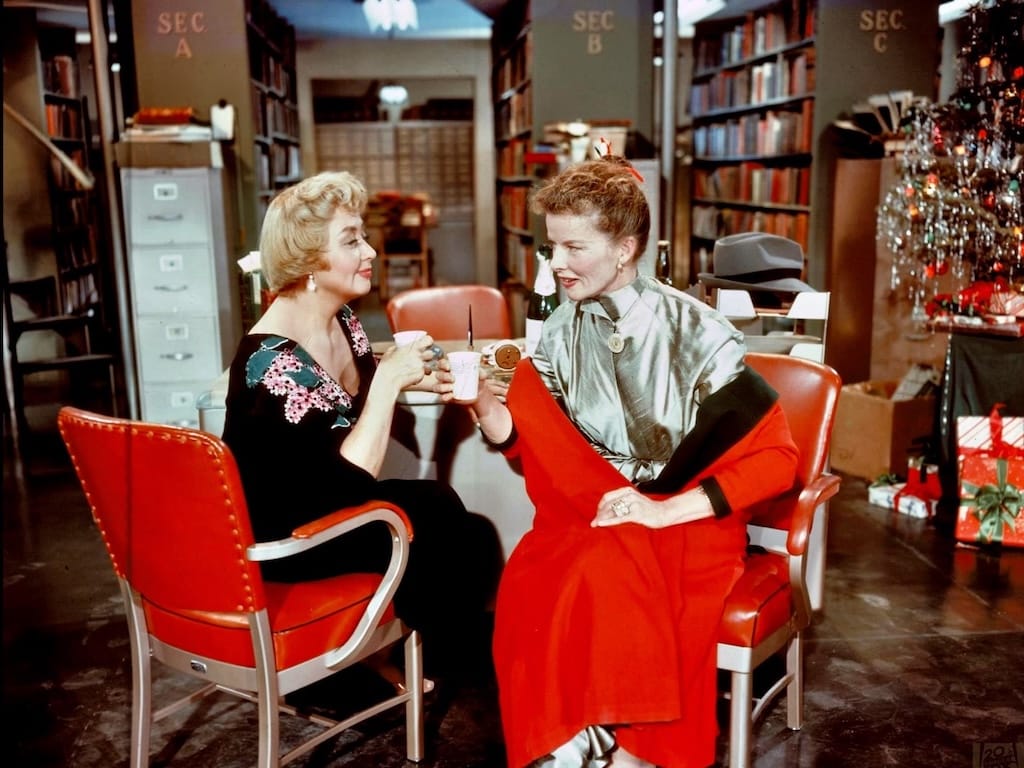
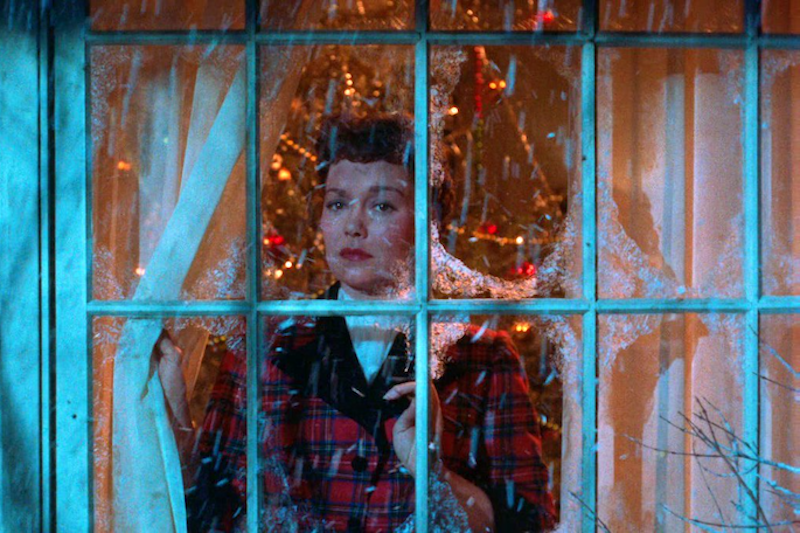
I'm not here to yuck anyone's yum, but why the fuck would you watch Hallmark Christmas movies when Douglas Sirk's "All That Heaven Allows" exists? It's shot in Technicolor, features an insane array of coats, and uses fireplaces as a love language. It is the perfect Christmas movie that, yes, is melodramatic, but in exactly the way you might long for this time of year. If you haven't seen it, I'm jealous as hell that you get to enjoy it for the first time ever, hopefully in bed with cats and a hot toddy while snow falls softly outside your window.
Cary Scott (Jane Wyman) is a young, affluent widow living in a fake New England town that is clearly supposed to be Connecticut. She has two college-aged children who I promise you will spend the entire movie cursing. This Letterboxd review says it all:

Cary is lonely, the people in her social circle are gossipy snobs, and her kids are away at college. She needs some excitement in her life, which comes in the form of her arborist, Ron Kirby (Rock Hudson), a man ten (?) years her junior. At the time of filming, Wyman was 38 and Hudson was 30, but I think we're supposed to assume a larger gap in the film. Ron is unlike any of the men in her circle. He has an unshakeable confidence that doesn't come from position or status. One of his friends tells Cary, "Ron's security comes from inside himself. Nothing can ever take it away. Ron absolutely refuses to let unimportant things become important." The two embark on a whirlwind romance, which is nearly derailed by absolutely idiotic shit, but obviously comes back together at the end. Fun fact: Sirk did not want this film to have a happy ending because, like me, he's a cynic who believes that sometimes, people fuck things up and don't get a chance to set them right; however, the studio forced his hand.
After you watch this film, check out Todd Haynes's 2002 homage/remake, "Far From Heaven," which expertly queers the narrative and adds a racial element. In Haynes's retelling, the husband (Dennis Quaid) isn't dead, but gay, and the gardener love interest (Dennis Haysbert) is Black.
Other notable mentions:
- "All That Heaven Allows" is based on a 1952 novel by mother-and-son writing team, Edna and Harry Lee. One of Edna's other books, "The Queen Bee" (1949), was also adapted into a film with Joan Crawford.
- The screenplay for Sirk's adaptation was written by Peg Fenwick, who never seems to get any credit for the picture's success even though the wry, economical wit comes directly from her.
- Rainer Werner Fassbinder has an adaptation that doesn't take place during Christmas, but is likewise worth watching: "Ali: Fear Eats the Soul" (1974). You can read Fassbinder's thoughts on Sirk's film in the New Left Review.
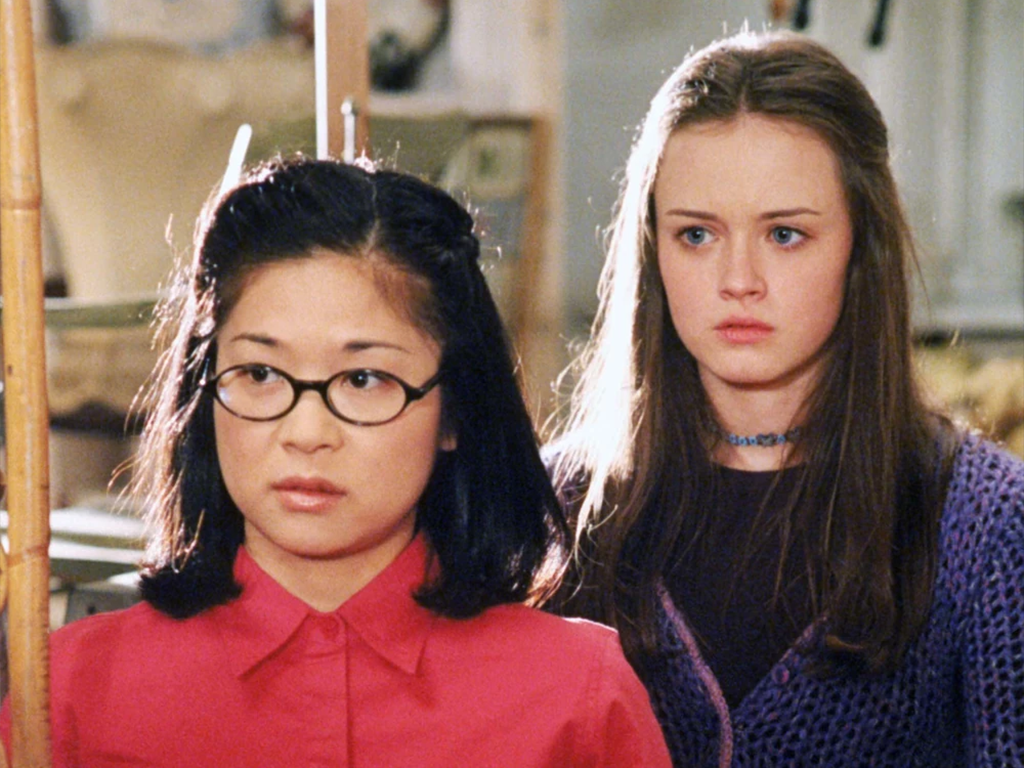
Watch if you like: Pedro Almodovar, the DAR scenes in "Gilmore Girls," emotional intelligence, pigeons as wingmen, fantasizing about living in a greenhouse, Agnes Moorehead in jewel tones, "Mad Men."
I read this in August during my Wellbutrin sleep deprivation stretch, but I've been waiting until December to include it because it takes place right before Christmas. The setting: a flailing, soon-to-be-shutdown Red Lobster outside a New England mall in the late 90s/early aughts. The protagonist: Manny DeLeon, manager, a guy in his mid-thirties who really cares about his job in a way that's somehow more endearing than pathetic. The Lobster's final day takes place in the midst of a blizzard and, because many workers are on the brink of unemployment, the restaurant is tense and short-staffed. Since Manny, and a few employees he's chosen, have new jobs lined up at Olive Garden, there's an us vs. them vibe amongst some of the staff. A line cook named Fredo exits in a huff after one slight too many, leaving slashed leather jackets and a damaged car windshield (c/o potato masher) in his wake.
For anyone who has worked in food service, there are many recognizable archetypes, like the wizened, highly efficient career server. Here's how O'Nan describes her:
Roz is spraying down her section, all elbows and scrawny arms, her Clairol-blond ponytail bobbing as she swabs the tabletops. Despite her girlish barettes [sic], Roz is old enough to be his mother. She's a pro, with black nurses' shoes and calves like a mountain biker—and a lifer, the only one fully vested in Darden's retirement plan. They don't even make the nametag on her uniform anymore; he's tried finding it on eBay.
While there are shades of failed romance between Manny and Jacquie, his college-aged co-worker, the novella is more about time/place/vibe than any specific relationship or even character. It perfectly captures this period in America where the economy was booming, but blue collar workers were getting laid off (outsourcing, corporate consolidation, restructuring) or demoted, dealing with stagnant wages, poor working conditions, and a nonexistent social safety net. O'Nan isn't overt about any of this, allowing his quiet, simple story of quotidian disappointment to stand on its own. Did Manny vote for Trump in 2016? The depressing answer is probably yes.

Read if you like: "The Flick," Barbara Ehrenreich, Howard Zinn, Mike Leigh, Appalachians with better politics than JD "Couchfucker" Vance, capitalist despair.
Before it became inundated with BookTokers and West Village Girls, I used to love browsing the stacks at McNally Jackson. I still love it, I just can't stay for longer than ten minutes without risking a hemorrhagic stroke. I'm trying to be less judgmental of the younger generations, but I've never seen anything lamer than a person on their phone, recording a reel in public. It's cool that these youths want to get people excited about reading, I just wish they could find a less annoying way to do it. I don't understand why millennials are "cringe" (god, I hate what mainstream journalism has become) and this behavior somehow isn't. I'm at the age where I completely understand why older people stay ignorant to emerging trends. If I could, I'd move to the middle of the forest and spend the rest of my years in silence. Or maybe, like Mrs. Unguentine, I'd set sail on a barge with a magical garden deck and spend forty years out at sea (sans abusive, greasy, alcoholic husband).
I wasn't aware of Stanley Crawford's short novella, "Log of the S.S. The Mrs. Unguentine" until one of those McNally Jackson trips where I spotted it on the new arrivals table. Dalkey Archive Press always gets my attention, so it was a mindless "add to bag." I read it over maybe 90 minutes, split between an Americano from Zibetto and my train ride home. Initially, my reaction was "hmm." The concept is great and the characters are intriguing, but I found the prose challenging. Sentences are long and poetic in a way that, if your mind wanders at all, can easily result in lost threads. I'd get to the end of a page and have no idea what had just happened or what I was supposed to be visualizing. It also doesn't help that the timeline often shifts without warning.
When we first meet Mrs. Unguentine, her husband, who she has been on this barge with for forty years, has just drunkenly, yet purposefully, leapt overboard with their only set of nautical charts in his pocket. The rest of the book is her reminiscing about their life together, wading through complex sadness and trauma interwoven with great absurdity. The book is written in the first person from Mrs. Unguentine's point of view — it's the ship's log, hence the title and each chapter's varied focus — but she's a tough character to pin down. Even though he's dead, the weight of Mr. Unguentine is still on top of her, crushing her spirit and distorting her worldview. On first read, I was distracted by all of these elements, trying to parse out what was happening to the detriment of my enjoyment. On second read, which happened partially aloud to my husband before bed, I split the story into three chunks and enjoyed it significantly more this way. If you can get on this book's wavelength, it has a lot to offer, including gems like this:
The seas, the seas, how I hated them then, and all their waters which glided us from chicanery to chicanery and in our wake, our youth, oil smears iridescent of all that might have been; but never was, never will be. Instead, we threw a great tent up over the barge, over the tops of the young tree, and conducted nautical orgies in tropical seas for bevies of wealthy yachtsmen who traded griping paramours before our very eyes, our open palms and ten per cent, and who would scramble up the tree-trunks to drape themselves nude from limbs, jeering down, and everything would be the noise of boughs cracking and leaves being stripped from twigs, nights of it, years of it. Unguentine drank; my fury went into tossing salads.

Read if you like: Marlen Haushofer, "Don Quixote," Jules Verne, Ingmar Bergman, Sophie Lennon in "Miss Julie," control freaks, the feeling of being sick in bed with a fever that causes hallucinations.
My friend Vlah sends me good music recommendations all the time, including this beautiful song by Nathan Evans Fox that someone on Reddit described as this generation's version of Woody Guthrie's "Jesus Christ" (1940). Fox says,
One of the few uncomplicated things I appreciate about my fundamentalist upbringing is the ways we were given space to sing as earnestly as we wanted regardless of our technical proficiency. It’s a beautiful thing to hear folks who can’t hold a tune belt a song in a space where no one will judge their performance. I tried to make the best possible version of that in the production by getting some great musicians in the room and encouraging them to sing for the feeling rather than the technique. I hope this song feels like church in a cinderblock building with a water-stained drop ceiling where the potluck is greasy and the message is about getting everybody free.
A Bible Belt hymn about liberation? A-fucking-men. I also like what Fox — who is from Glen Alpine, North Carolina — said in this interview with Sojourners, so I'm quoting it in full even though it's long:
Part of being a hillbilly is that I’ve been raised on a different kind of cultural diet than people in academia or coastal people, whatever. The cultural cornerstone where I grew up is church. I’m not talking like your mainline First Baptist Church. I’m talking about the gas station that has 10 people in it, and we pull up with the PA system every Sunday. It’s the flea market; it's the Walmart parking lot. I can tell you where I was when Dale Earnhardt died. It’s those kinds of cultural spaces. That’s my cultural diet.
Now, the liberal establishment has abandoned those spaces. It doesn’t have anything to say to them. They’ve left those spaces to be grifted by conservatives and far right interests. There’s this giant cultural expanse of folks who represent working class interests — and I don't mean that just in the white sense, just to be very clear. I mean blue-collar folks who live paycheck to paycheck, folks who don't read The New Yorker.
I think people have realized that being liberal isn’t enough. I was born in 1989. My hometown was wrecked by the recession, was wrecked by NAFTA. These were things that Republicans and Democrats collaborated on. And so, these spaces need more than what liberals can offer. For a while, folks had a little bit of hope that maybe we can liberal our way out of this. Maybe we can pretend that American progress will save us. I think that's done. Now folks are looking for something that’s got a little more struggle in it and a little more anger and a little more rage and a little bit more grief. That reframes where your hope is and where your action is too.
Here are some gift ideas for kids. I'm not a parent and have no idea what's trendy or even really age appropriate; however, there are many children in my life who I routinely buy shit for, so please learn from my successful wild stabs in the dark. I'd guess most of these things are suitable for kids between four and ten, although I wouldn't be mad if someone bought them for me now.
- Something with an element of suspense, like a surprise ball, Christmas cracker, blind box, cootie catcher, or magazine subscription. Give those little fuckers something to look forward to and make them wait patiently to receive it. For example — if you're giving this gift in person — tell them they can unwrap one treat from the surprise ball for every ten minutes they allow you and your friend to talk uninterrupted. Everybody wins!
- Things that I had and loved (or desperately wanted) as a child:
- A diary with a lock
- Stuffed snail in a purse
- Nesting dolls
- Slime timer
- Glittery or glow-in-the-dark tattoos
- Scented pencils, novelty erasers, and Gelly Roll pens
- A snow globe picture frame or cups
- Lava lamp, which, contrary to Taylor Doose's belief, you don't need to be on drugs to enjoy
- Ch-ch-ch-chia (and why not get them a Clapper, too?)
- Cute flannel sheets
- Estate sales are the perfect place for kid gifts. Look for walkie talkies, shiny trinkets, skateboards, graphic t-shirts, puzzles/games, books, Polly Pockets, Skip It, I Spy books. Is it ok to give someone a used gift? Hell yeah. Kids break things, get sick of them, and often already own too much junk. If you can, absolutely avoid buying them something new. They won't care or know the difference (and if they do, their parents are probably assholes). That being said, I've never met a kid under 10 who didn't love a ZipString.
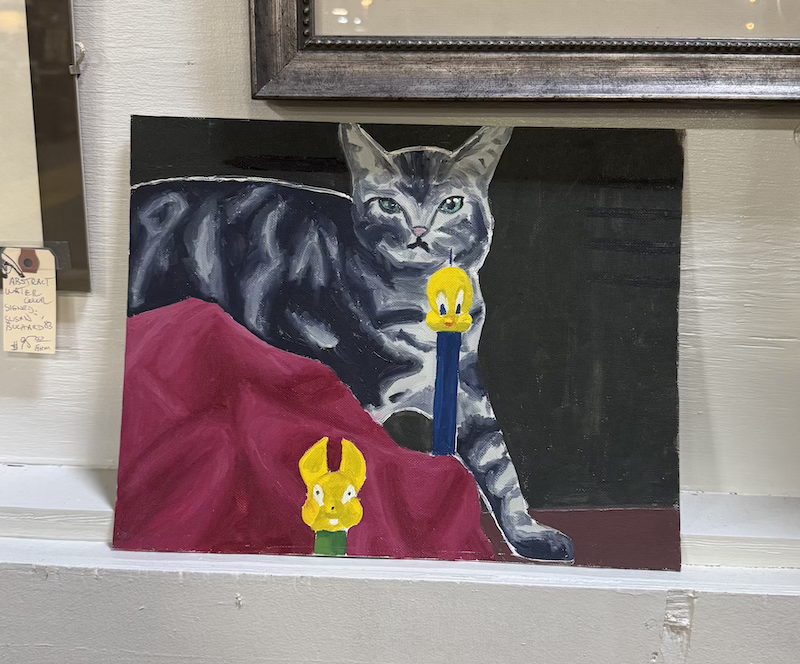
My husband told me to add the HyperWhistle to this list, but I actually like all of my friends, so I can't in good faith make such a diabolical recommendation.
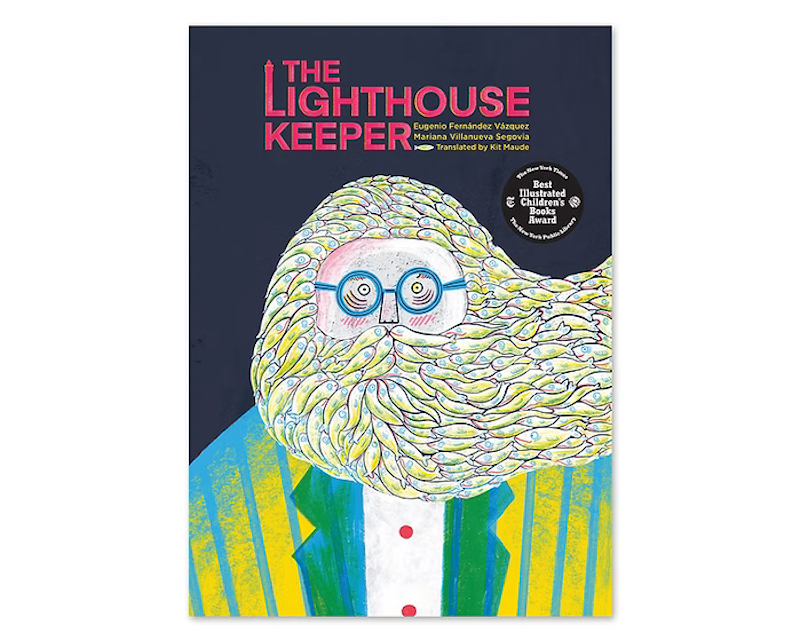
Per usual, I leave you with a dope children's book illustration, this one from Mariana Villanueva Segovia. I want a framed poster of this for my house: