
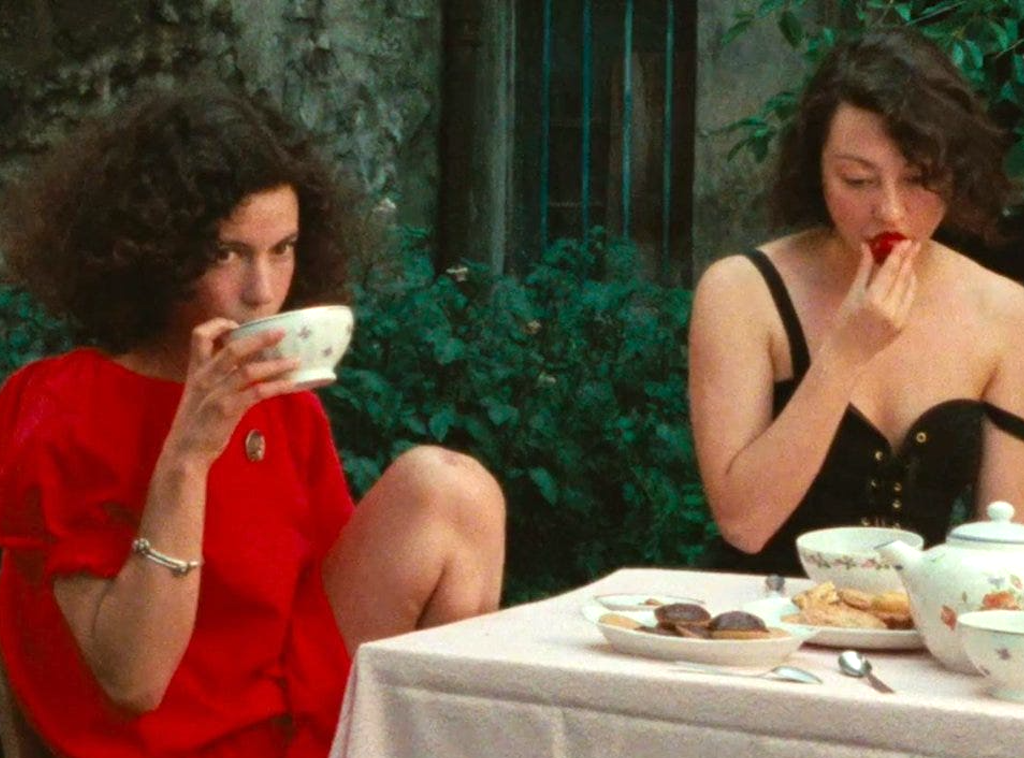
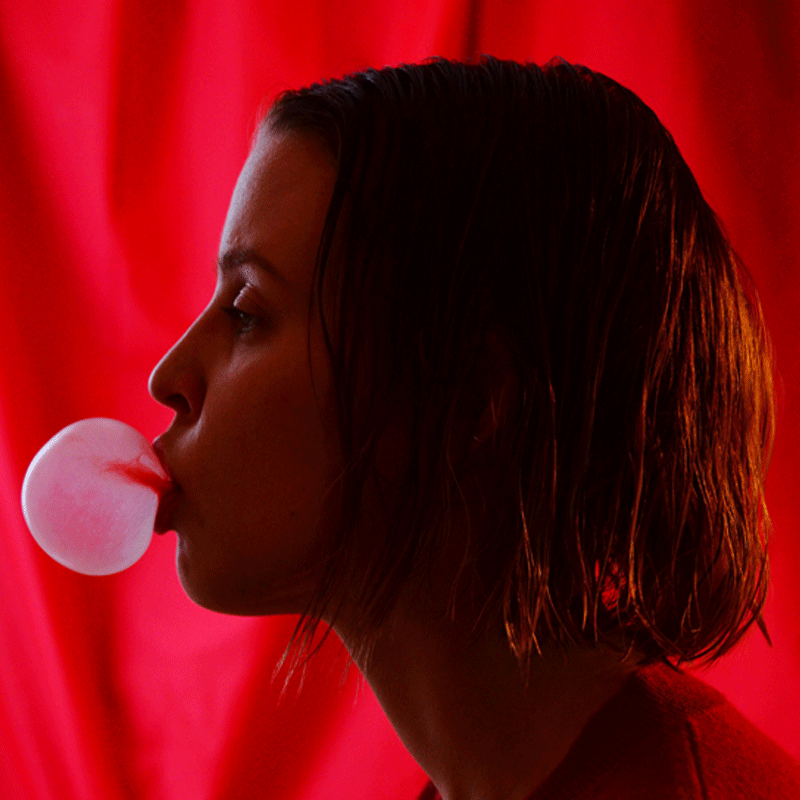
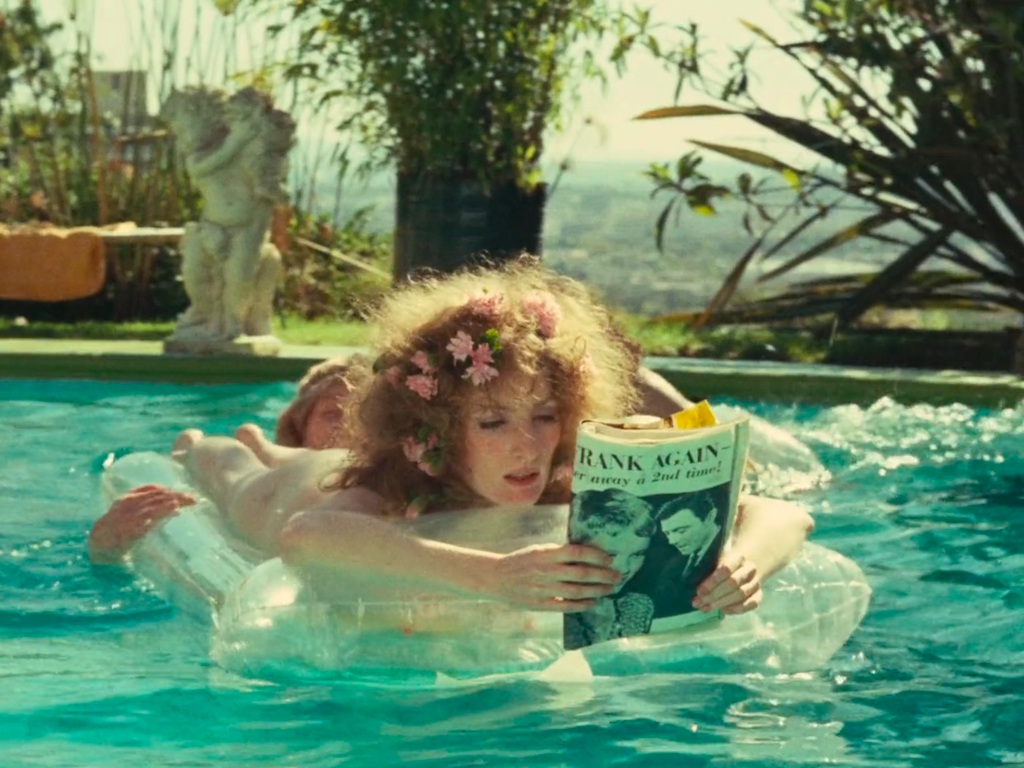
It's been six weeks since my last missive, so if you signed up for Friday Night Dinner and wondered where the hell it's been, well... here it is. I'm writing this on the summer solstice in utter disbelief that we have three whole months of this shit. I appreciate summer more each year, but do I love being perpetually sweaty and getting eaten alive by mosquitoes? I do not. Maybe I'll enjoy it when I'm so old that my skin is translucent and I'm cold all the time. Of course, climate change will have taken its toll by then, so I imagine my old ass will perpetually exist indoors, channeling Julianne Moore in "Safe" (Haynes, 1995), instead of dealing with smoke-laden, flood-soaked, tick-ridden nature. Hooray for humanity! Every breath is a gift.
I've been absent from FND mainly because I'm singularly focused on a reread/rewatch of Elena Ferrante's "The Story of a New Name." If I can't spend my summer smoking cigarettes on Maronti and/or Citara beach like Nino Sarratore, I can at least live vicariously through the middle chunk of the book, which all takes place on Ischia. If you're interested in following along as I move through the narrative, update your email preferences to include TV recaps. To find out what else has tickled my fancy lately, keep reading.

P.S. I'm about 3/4 of the way through Kiran Desai’s "The Loneliness of Sonia and Sunny" (2025), and I'm actually pretty resentful that writing this newsletter is forcing me to take a break from reading it. It is very good and will surely be featured in the next FND.
🦷 Katie Dippold's "Widow's Bay" (2026)
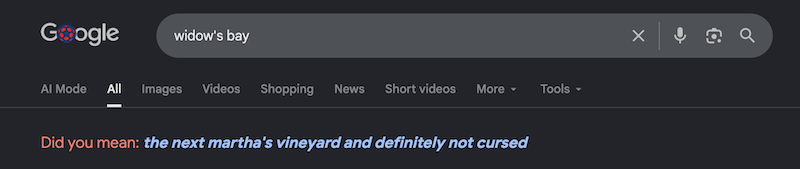
When something is wildly popular, my immediate impulse is to talk trash because I'm a contrarian little sourpuss; however, I can't do that with the delightful "Widow's Bay," which won me over from the first scene, an homage to "The Fog" (or some say “The Mist“) featuring the harbormaster, his cat, and a staticky TV playing "Family Feud." No matter how hard Mayor Tom Loftis (Matthew Rhys) tries, Widow's Bay will never be Martha's Vineyard. For one, it's... haunted? Possessed? A sentient being that runs on blood sacrifices? You'll have to watch to find out, but the tl;dr is that shit ain't right in this New England island town. The evidence:
- The Breakwater Inn, a place so creepy that even the proprietor won't stay overnight. Guest amenities include the (literal) time warp captain’s suite and a stack of board games in the parlor including "Teeth," AKA a pair of pliers.
- Creatures like the Sea Hag, the Boogeyman, Willy the Clown, a sinister self-help book called "Your Turn: Out With the Old and in With the You," Ugly Hortense, and something underwater with tentacles.
- A Historical Society full of framed town articles of yore, including "Cannibalism in God’s House" and "Priest Eaten by Whale."
- The fact that no one born on the island is able to leave without suffering dire consequences.
- Extreme weather events, like fog and tornadoes, that meteorology can't explain.
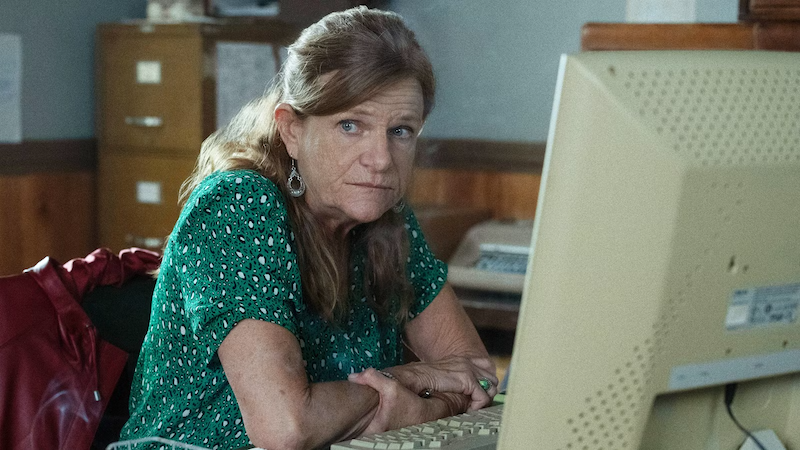
There are certain actors, like Rhys, that I love watching enough to suffer through almost anything (cough "The Beast in Me"), so it's especially exciting when they're in a project/cast on par with their talents. Dale Dickey, Stephen Root, Kevin Carroll, Kate O'Flynn, Hamish Linklater, Betty Gilpin, and K Callan all have standout moments in the first season that could go straight onto an Emmy reel. It probably feels like I've mentioned too many names, but there are also many wonderful actors in small roles that make the show what it is, like Bashir Salahuddin, Jeff Hiller, and Chris Fleming. With the success of S1, I'm nervous about stunt casting and hope S2 doesn't go in that direction.
Creator Katie Dippold is probably best known for her work on "Parks and Recreation," along with her Paul Feig collaborations ("The Heat," "Ghostbusters: Answer the Call"). Her approach to this series is incredibly smart, with a self-contained story in each episode and a season-long arc, both sufficiently packed with breadcrumbs to keep the viewer invested in the central mystery and general town lore. Directors — including Hiro Murai ("Atlanta"), Ti West ("X" trilogy), Samuel Donovan ("Severance") and Andrew DeYoung ("The Chair Company") — execute the referential, genre blend vision without ever going too big or leaning too hard in the comedy or horror direction. If you still haven't watched, it is the perfect summer series and likely miles better than anything else we're going to get.
Watch if you like: horror movie trivia, "Buffy the Vampire Slayer," "Murder, She Wrote," "Lost," Stephen King, small town weirdos, Wendy Torrance, "Wayward Pines."
⛴️ T. Kira Madden's "Whidbey" (2026)
T. Kira Madden's debut novel "Whidbey" (she previously wrote a memoir, "Long Live the Tribe of Fatherless Girls") is a swift kick to the groin. In the content warning, she describes it as "a novel largely about suffering, the commodification of pain, and the refusal to see it and to name it in others." It's the story of three women — Birdie, Mary-Beth, and Linzie — all connected to the same pedophile, a man named Calvin Boyer, and their attempts to contend with the destruction he's wrought over nearly a decade of their lives. Each woman is given dedicated chapters, written from varying points of view, until the third section of the book where the narrative opens up and the voice changes once again. Madden plays with perspective in a complicated way that feels completely intuitive when reading but begs for post-mortem dissection.
The book begins with Birdie, the only character written in first person, as she travels to Whidbey Island, a place she's chosen for a digital detox now that her former abuser is back in the news c/o a recently published book by Linzie, one of his other victims. When Birdie declined to be interviewed for the book, Linzie chose to mention her under an (offensive) pseudonym using information from public court records. Now Linzie is profiting off of Birdie's trauma, their trauma, and dredging up all kinds of emotions Birdie is ill-equipped to process. On the ferry from Seattle to Whidbey, she meets a man who offers to kill Calvin and spends the rest of the book wondering if he followed through (as does the reader).
The first section switches back-and-forth between Birdie and Mary-Beth, Calvin's mom, a steadfast supporter who defends her son through his extensive legal issues and deserved social ostracization. The best way I can describe her is as a character Dale Dickey would play: a leathery, skinny cigarette smoker who slams tiny bottles of hooch and works at a North Pole-themed gas station in Florida. Everything about her is loathsome, yet Madden urges you to empathize with her. I initially struggled to embrace "Whidbey" because spending time in Mary-Beth's head (thankfully in third person) was so unpleasant, but try to push past this and trust that it serves a purpose. Even after I finished the novel, I was convinced her story contained the novel's only big missteps until I thought about it more and realized what Madden was doing.
In the second section, Linzie gets her own chapters, also written in third person, and moves from Birdie's distant nemesis to a fully fleshed out character with much less autonomy than everyone assumes. She makes many idiotic decisions over the course of the novel that you understand because of how Madden presents her trauma and its aftermath. The third section of the book moves to close-third perspective to wrap up each of the character's stories and the novel's central mystery. I've seen some reviews present "Whidbey" as a queer, Tana French-style whodunit and to some extent, I guess that's accurate, although I worry that people who go into it with that in mind aren't going to be prepared for the psychological wallop, so proceed with caution.
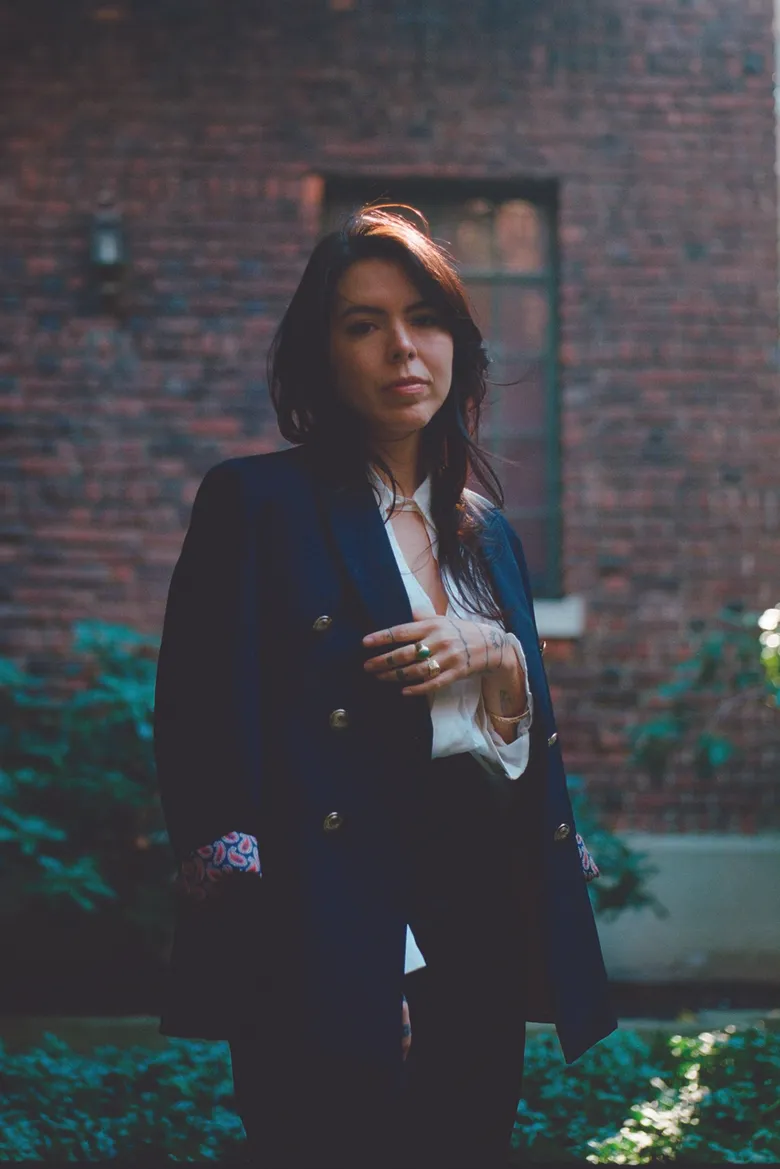
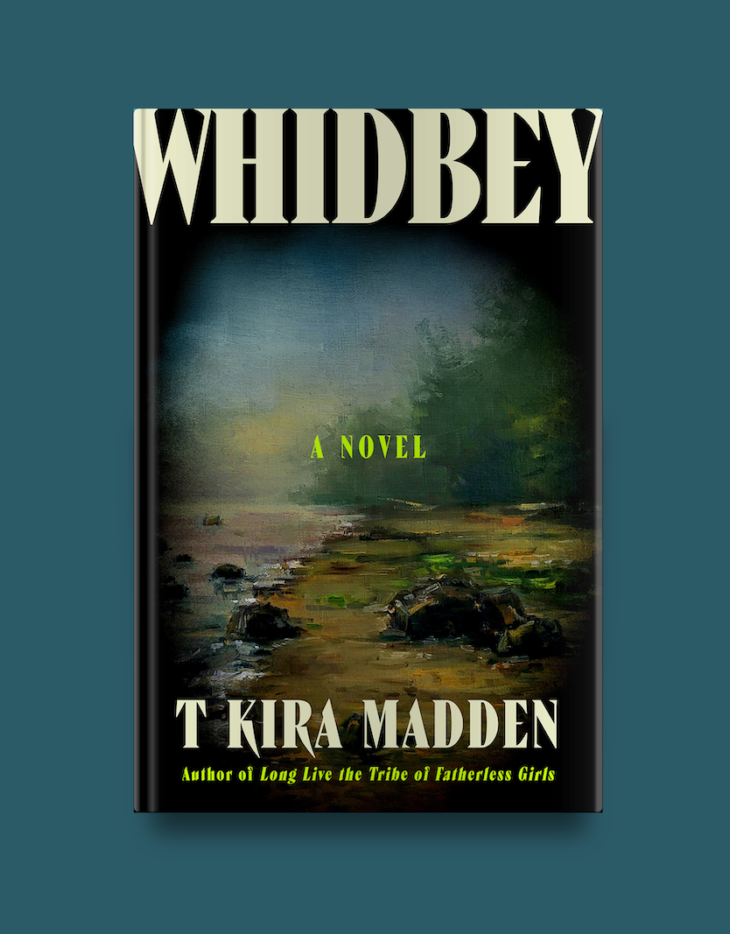
A good author photo and a good cover? Rare combo.
Read if you like: "Sound of Falling," "My Dark Vanessa," "The Killing," "Bron/Broen," stories steeped in nihilism that aren't devoid of joy, well-written queer sex scenes.
🕗 Tsai Ming-liang's "What Time Is It There?" (2001)
What I love most about New York City is that sometimes you have plans to see a 25-year-old movie at 7pm on a Sunday and it sells out that morning. People see movies in theaters here. They get popcorn, they laugh, it is a collective experience. Sometimes, usually at a place like Metrograph where the seats are uncomfortable and the clientele is specific, it's an annoying experience, but it's better than always watching movies alone. Anyway, I eventually made it to a second screening of "What Time Is It There?" last month and was delighted to find it nearly sold out, too.
Tsai Ming-liang has written and directed eleven feature films, of which I had only seen a handful, so I was keen to cross more off my list. He's a slow cinema guy interested in alienation, unrequited longing, and depression, so it's no shock I'm drawn to his work. Here's what I wrote in my journal after watching the film:
"What Time Is It There?" is one of those movies where not much happens but you leave feeling like days have passed and you've changed because of what has taken place. It's about a guy, Hsiao-Kang (Lee Kang-sheng, Ming-liang's platonic life partner/collaborator), whose dad dies. His mom is deep in the mourning process, up all hours of the night, convinced her husband is going to come back in another form. Hsiao-Kang starts peeing in bottles and bags in his room to avoid interacting with her. He works as a street watch vendor in Taipei and meets a woman, Shiang-chyi (Chen Shiang-chyi), who wants to buy the watch off his wrist because she likes it and it keeps dual time. She needs it immediately since she's leaving for Paris the next day, but he says it's bad luck for him to sell it to her because he's in mourning. She begs him and he relents.
His days are all very similar. He sells watches, deals with his sad mom and her antics, pees in his already too full bottles. He calls a number to ask what time it is in Paris, then begins changing every clock he sees to Paris time. He also goes to a movie store to buy or rent something set in Paris and ends up with "The 400 Blows" (later, there is a Jean-Pierre Léaud cameo). It's not clear if he has a crush on Shiang-chyi, but probably. He doesn't connect with anyone else in the films, sans a sex worker who fucks him before stealing his case of watches. Everything is minimalist — dialogue, camera movement. The pace is slow.
In Paris, Shiang-chyi is lonely and isolated in much the same way. She walks around the city but doesn't speak the language and has no one to share anything with. She meets a woman from Hong Kong after vomiting in a cafe bathroom and being shown some kindness. They end up sleeping together and then weirdly parting in the wee morning hours. Shiang-chyi goes to the Grand Bassin Rond at the Tuileries Gardens and falls asleep in one of the green metal chairs. As she snoozes, we watch some boys steal her suitcase and then later see it floating in the pond as another man (someone significant) fishes it out with his umbrella. It's a movie of sad little vignettes and mishaps without any overt happiness.
If you find this description enticing, go forth. If it sounds too depressing, just know it's the cheeriest Ming-liang film I've seen.
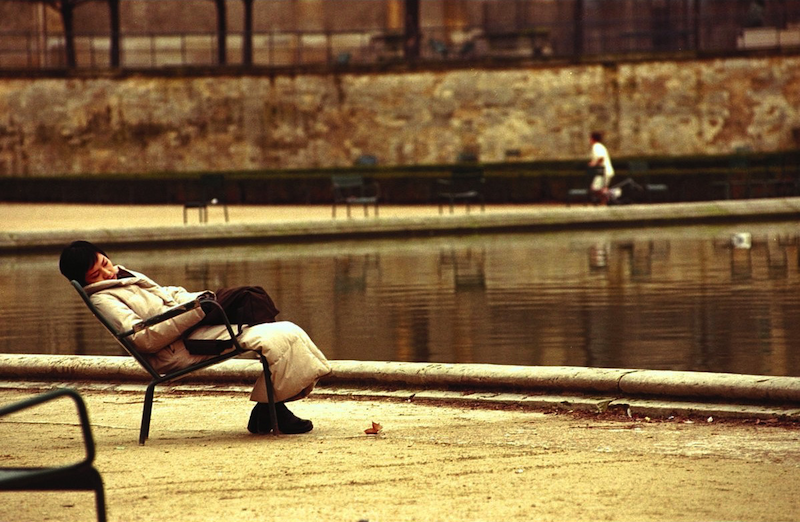
Watch if you like: Chantal Akerman, Apichatpong Weerasethakul, piss, "No Longer Human," feeling like a misfit in a foreign country (or your own).
🪿 Sasha Waters's "Mary Oliver: Saved by the Beauty of the World" (2026)
This is a standard, albeit well-constructed, talking heads documentary, so it's hard to get excited about it from a formal perspective. With docs that fall into this category, I generally feel they're worth watching if you're already a fan of the featured subject or have some curiosity about them. Going into it, I had baseline familiarity with Oliver's work/life, but it was nice to come away with a fuller picture of who she was outside of over-quoted poems like "Wild Geese" and her intense later-in-life popularity. Over the years, I think I projected a lot onto Oliver based on snippets of what I thought I knew about her and this documentary made me realize, "Baby, you were wrong."
For as long as I've been interested in poetry, Oliver has been practically shoved down my throat (better her than Wendell Berry). As previously stated, I am and have always been skeptical of things that too many other people like because people are stupid, so why would I trust their opinions? There's no doubt that Oliver is tremendously talented but for me, her work is very situational. If I'm in the wrong mood when I read it, I'm going to roll my eyes in an act of cynical dismissal. This isn't to say it's not good and isn't worthwhile, it's just not for me most of the time.
Generally, I just don't really vibe with the type of person who earnestly writes, "You only have to let the soft animal of your body love what it loves." You might see this quote on a bumper sticker next to another bumper sticker that says, "My tummy hurts and I'm mad at the government." This probably makes me an emotionally challenging person whose negativity will eventually take a toll on your psyche, but no amount of therapy/drugs is going to eradicate that worldview; I am who I am. My favorite poets are the dark ones who eventually kill themselves or at the very least, spend eons in states of increasing irritation with the state of the world.
When someone is soft, sentimental, and palatable in their art, I assume they're also like this personally. The gag of it all is that Mary Oliver wasn't. She had demons, she just didn't wish to engage with them in her poetry. She smoked and drank copiously, truly did not give a fuck about other people's opinions (aside from her beloved, Molly Malone Cook), and seemed like an overall good hang. She also put in tremendous work and had great respect for her craft, grinding it out at or below the poverty line for nearly forty years before things really came together. I appreciate that the doc touches on this dichotomy between her personal life and public perception, directly addressing the haters like me who think they have her all figured out.
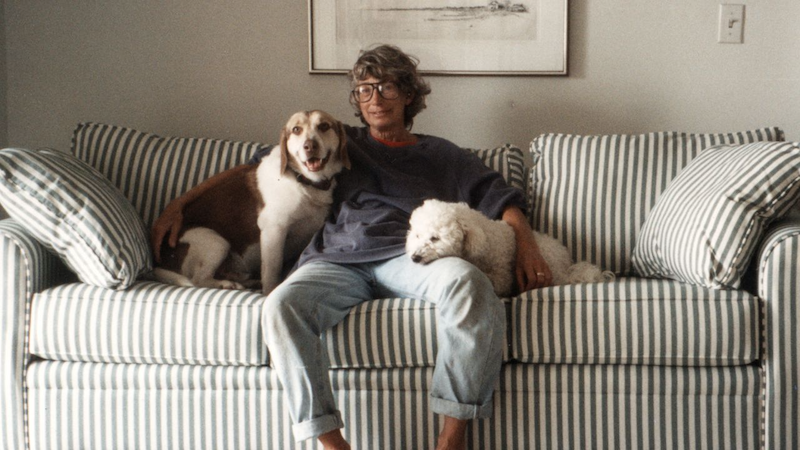
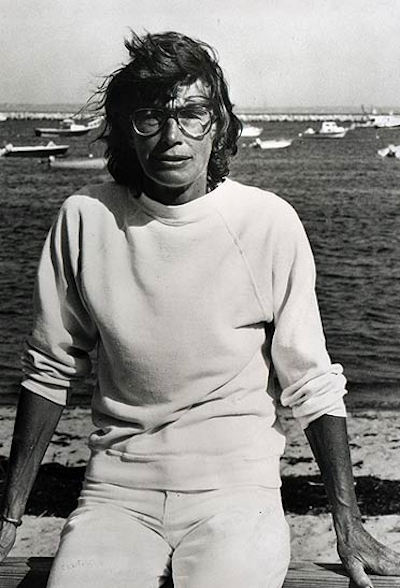
70s/80s Mary Oliver was, to quote Miss Patty, "pure sex walking."
Watch if you like: John Waters (release the uncut interview, please), enviable relationships in beautiful locales, countless dog cameos, Every Lesbian & Their Fashion.
🔥 Willem Dafoe in William Friedkin's "To Live and Die in L.A." (1985)
In 2018, I wrote about my fictional crushes and somehow, shockingly, did not include Rick Masters (Dafoe), the villain in "To Live and Die in L.A.," William Friedkin's comeback film after a handful of commercial failures that followed “The French Connection" (1971) and "The Exorcist" (1973). The more I rewatch Friedkin, the more I fuck with him.
"Bug" (2006) is one of the most disturbing movies I've ever seen and I don't think I'll ever see it again. Sometimes I think about the tooth extraction scene and feel like I legitimately might vomit. I think "Sorcerer" (1977) is a nearly perfect movie, especially when it's hot as balls and you wish to see your pain reflected on screen. "Cruising" (1980)? Inject it into my veins. There's so much dark lore around that movie, too. Friedkin had hired hospital techs for the cerebral angiography scene in "The Exorcist" and later learned that one of them, Paul Bateson, had been convicted of murder. He later partially confessed to, though was never charged for, the "bag murders," which became inspiration for "Cruising."
Anyway, back to Rick, a louche, urbane sophisticate who just wants to create art, light it on fire, make money, and fuck his girlfriend/business partner Bianca (sometimes accompanied by her girlfriend/business partner Serena who, yes, is Daphne from "Fraiser"). Compared to his foil, corrupt agent Richard Chance (William Petersen), he's practically a beacon of moral superiority. Like yeah, he's committing crimes, but at least he looks cool doing it, treats women with respect, and doesn't try to screw anyone over. He'll kill you if you cross him, so just don't cross him and everything is fine.
If he was a hypermasculine/traditional criminal, I'd probably find him gross, so it helps tremendously that in his first romantic scene, he briefly makes out with a man before the scene cuts and that man is replaced with Bianca (Debra Feuer). They've just finished a dance performance and are dressed similarly, so the scene leaves you wondering about what you just saw. Did Masters confuse this man, who looks remarkably like him, for Bianca, did he intend to kiss him, did our eyes just deceive us? It is delightful, I love it, and it would be an honor to get sliced by one of Dafoe's razor sharp cheekbones.
Now, as a little treat, here's the money-laundering scene for your viewing pleasure:
Wang Chung had their foot on the gas with this soundtrack.
✨ Quick hits
- The looks from this Judith Light interview are giving me life.
- Kennedy Davenport serving Elaine Stritch realness on "RPDR All Stars" S11 is easily a top ten lip-sync of all time.
- I became briefly obsessed with the "Call Her Daddy" drama last week despite zero frame of reference. It's a real curtains for Zoosha situation.
- In an attempt to use my idle scroll-time more wisely, I've been working my way through the artist profiles on Louisiana Channel and "Oregon Art Beat."
- I can't even look at Instagram anymore because my entire feed is videos of people discussing whether or not they want to have children. This is not content I seek out, engage with, or find particularly interesting at this point in my life. It feels like some menacing psyop shit. I guess my geriatric womb makes the algorithm go, "tick tock," which in turns makes me scream, "suck a bag of dicksssss."
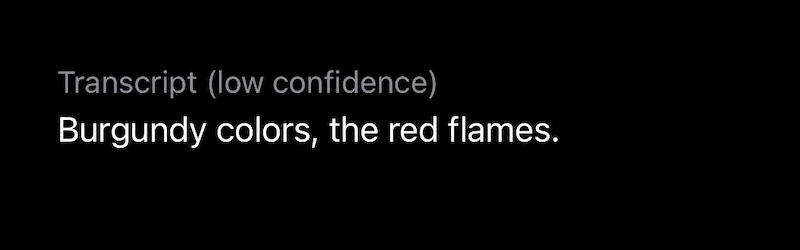
- I'm obsessed with this totally incorrect voicemail transcription:
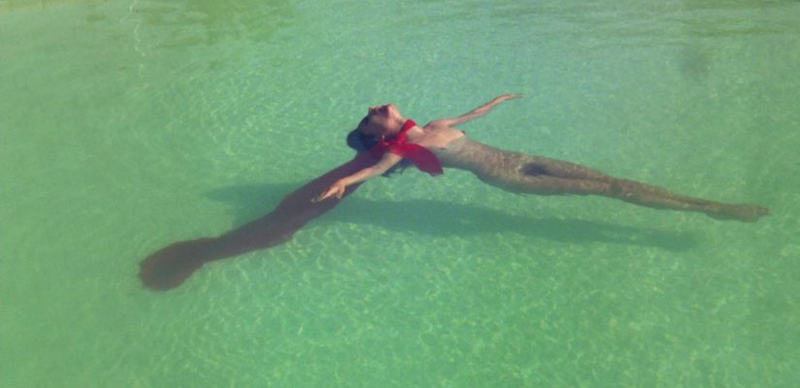
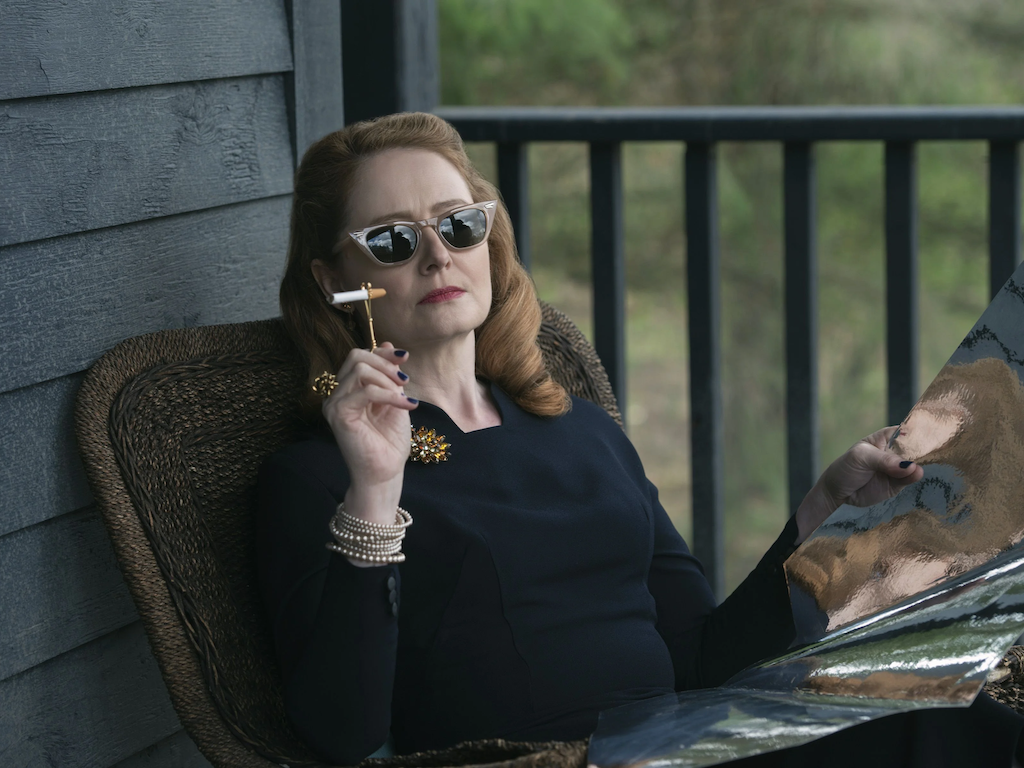
Until we meet again, this is where you'll find me:

Member comments