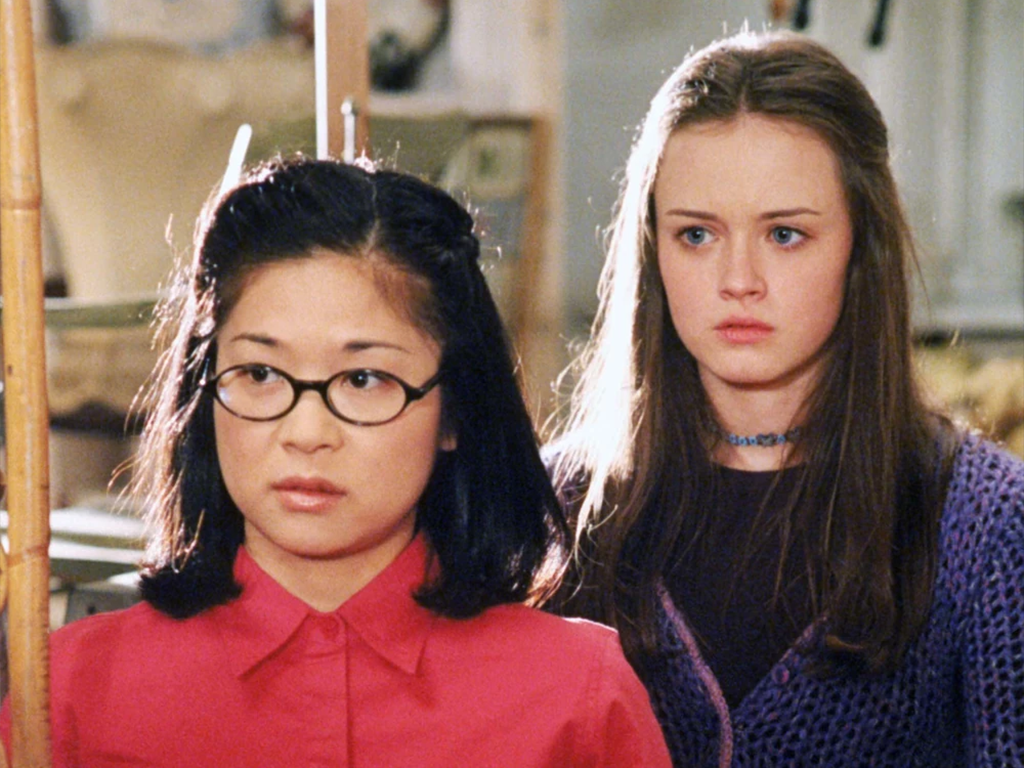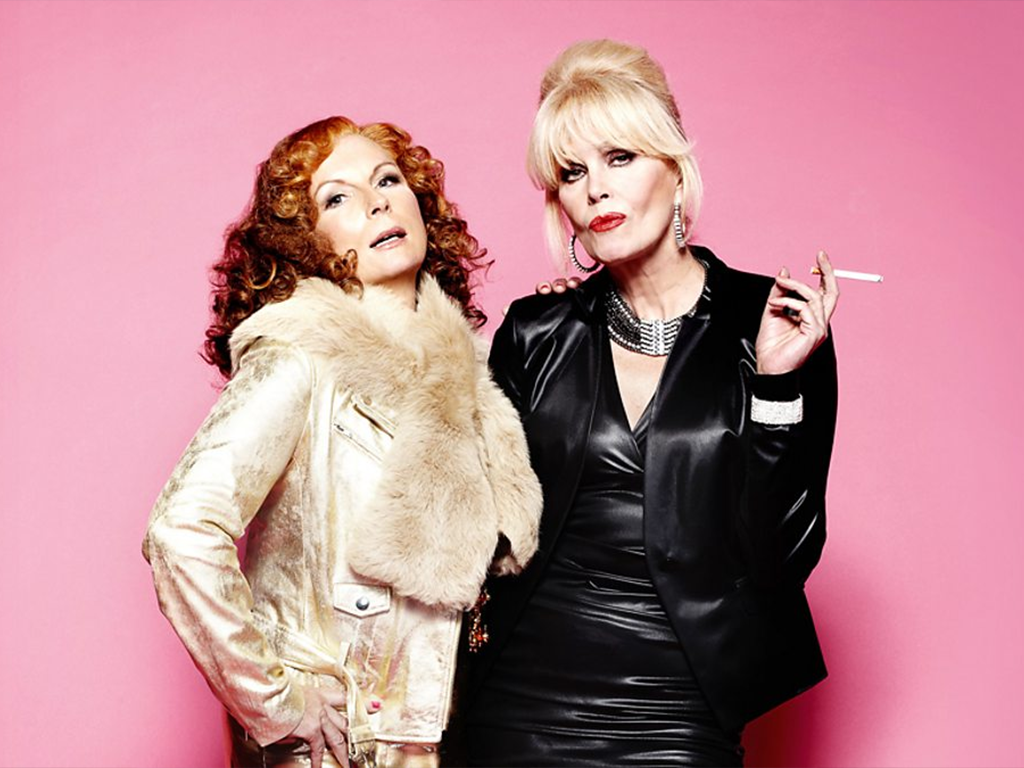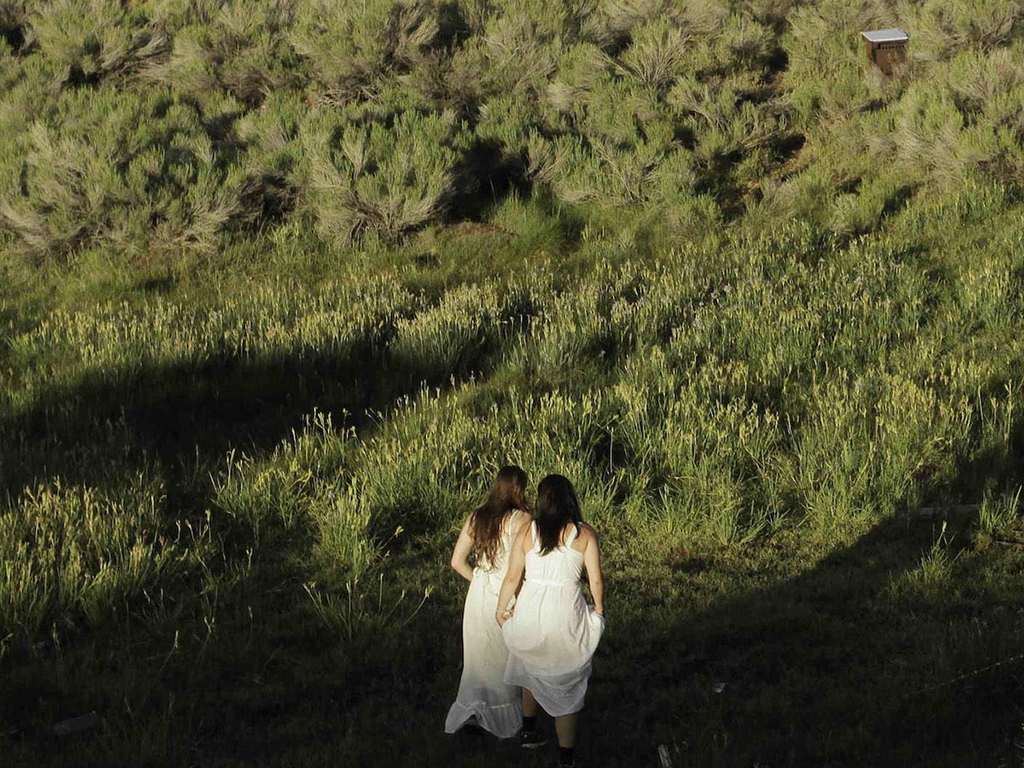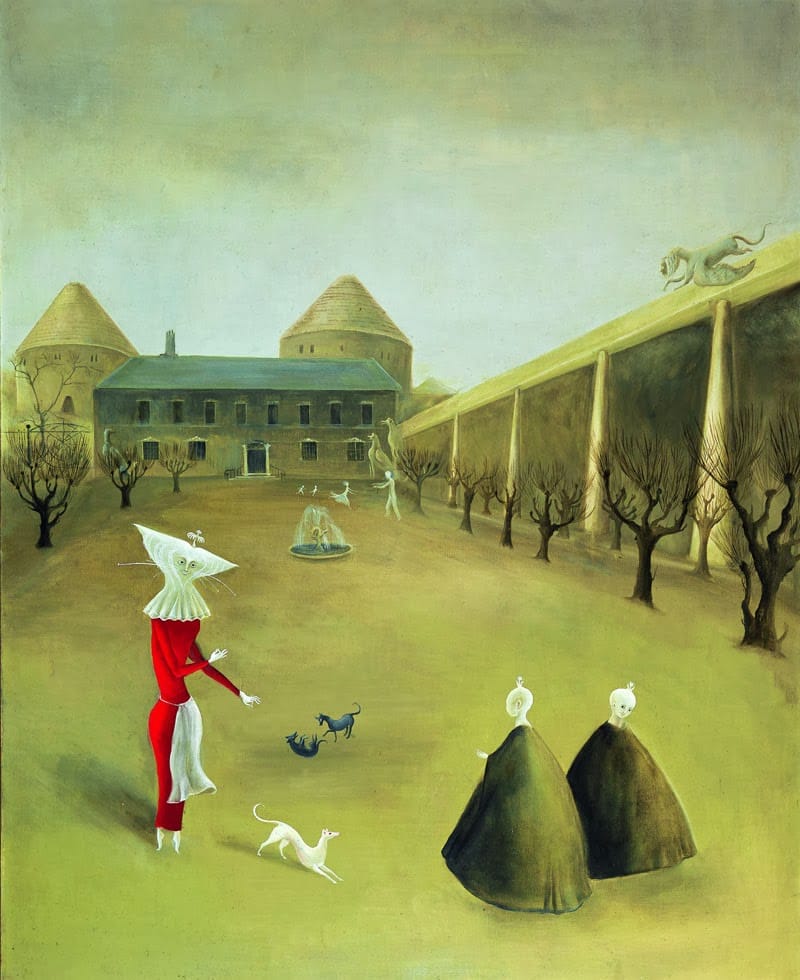
The vibe is obviously rotten, but let's momentarily pretend it's not for the sake of our collective sanity. As a kid, I spent most of my time envisioning various alternate lives and intriguing scenarios. For example, after watching "Amélie" (2001), I desperately wished to find a box of hidden treasures behind one of the loose tiles in my bathroom. For years, I tried, and failed, to transport myself to Aunt Vesta's house in the Other Realm. I thought so deeply about tapping maple trees and making sugar snow that I was sure I must have legitimately experienced it, maybe before my brain began storing memories.
Adults need more fantasy like this in their lives, more time spent languishing in hypothetical reality, especially when the world is crumbling around us. A therapist might call it maladaptive daydreaming but who gives a fuck; anything is better than the endless doomscroll that leaves you feeling more depressed and also insane. Instead of falling into the digital abyss, I'd like to spend more time concocting this type of delightful nonsense:
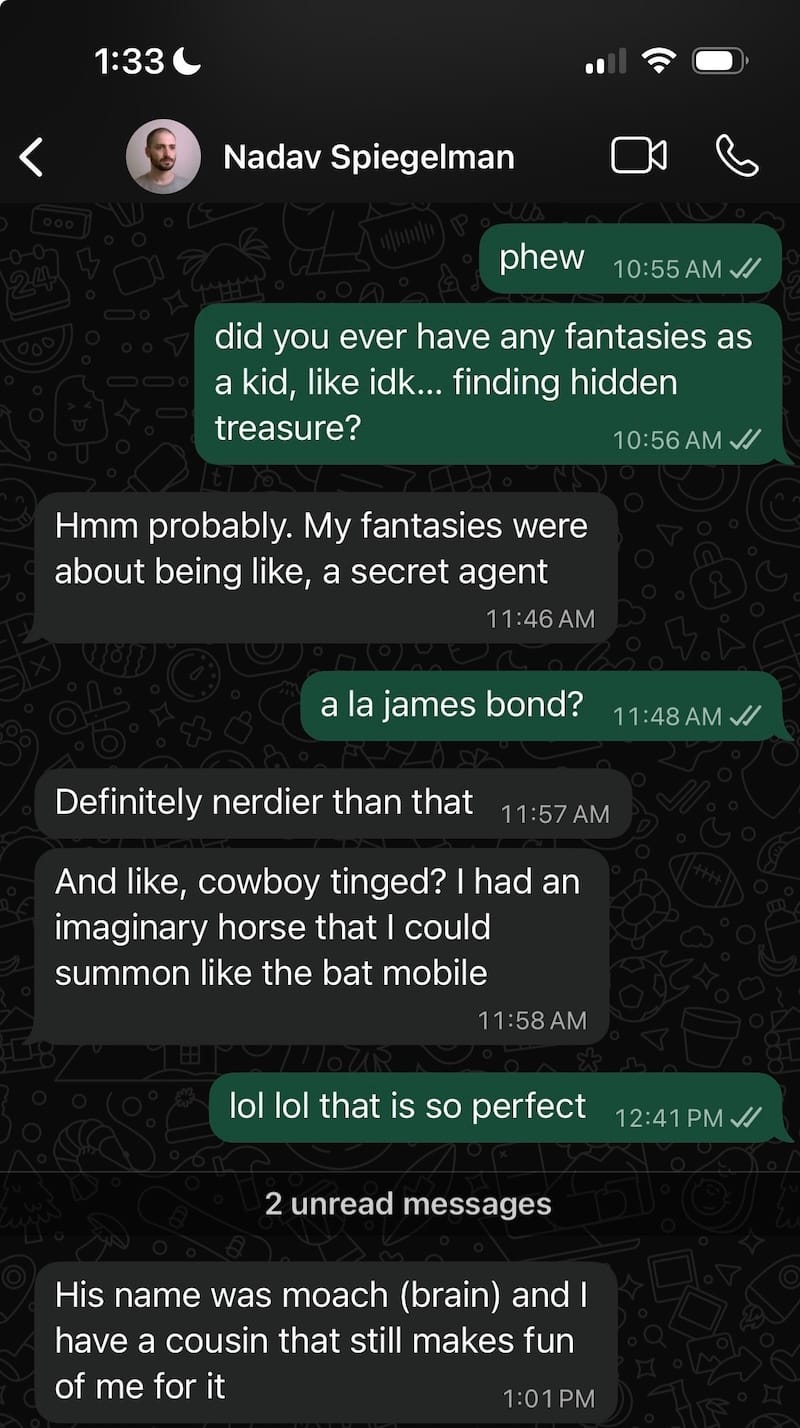
My mid-30s version of Brain the invisible Batmobile horse is probably something more like this:
It's a cold, snowy night and you're home alone, relaxing with a hot mug of Little Dickens tea that a thoughtful friend sent via care package. Ella's spinning on the turntable and the soft glow of 2300k lamps gives the whole place a sleepy, cozy feeling. You walk over to your bookshelf to find a suitable bedtime read and when you pull Jane DeLynn's "In Thrall" (1982) off the shelf, the whole thing swings forward, revealing a set of stone steps, flanked by flickering sconces. Remember when Dawn discovers the secret passageway in her old farm house in the ninth "Baby-Sitter's Club" book? Or when Nancy Drew wanders down a creepy hidden staircase in the Twin Elms mansion? It's like the Elsa Peretti-fied version of that, sans cobwebs. It's like if "Parasite" was more World of Interiors spread and less commentary on class inequality.
Anyway, you wander down the steps and when you reach the landing, you look out onto a sizable room with a giant, green velvet sofa and several overstuffed tapestry chairs. The walls, painted in Farrow and Ball Dead Salmon, are adorned with interesting art including what appears to be an original Leonora Carrington. A giant stone fireplace roars and an Arco lamp blinks on as you tiptoe along the terracotta floor draped in soft, strategically placed Persian rugs. Actually, just picture walking into this room:
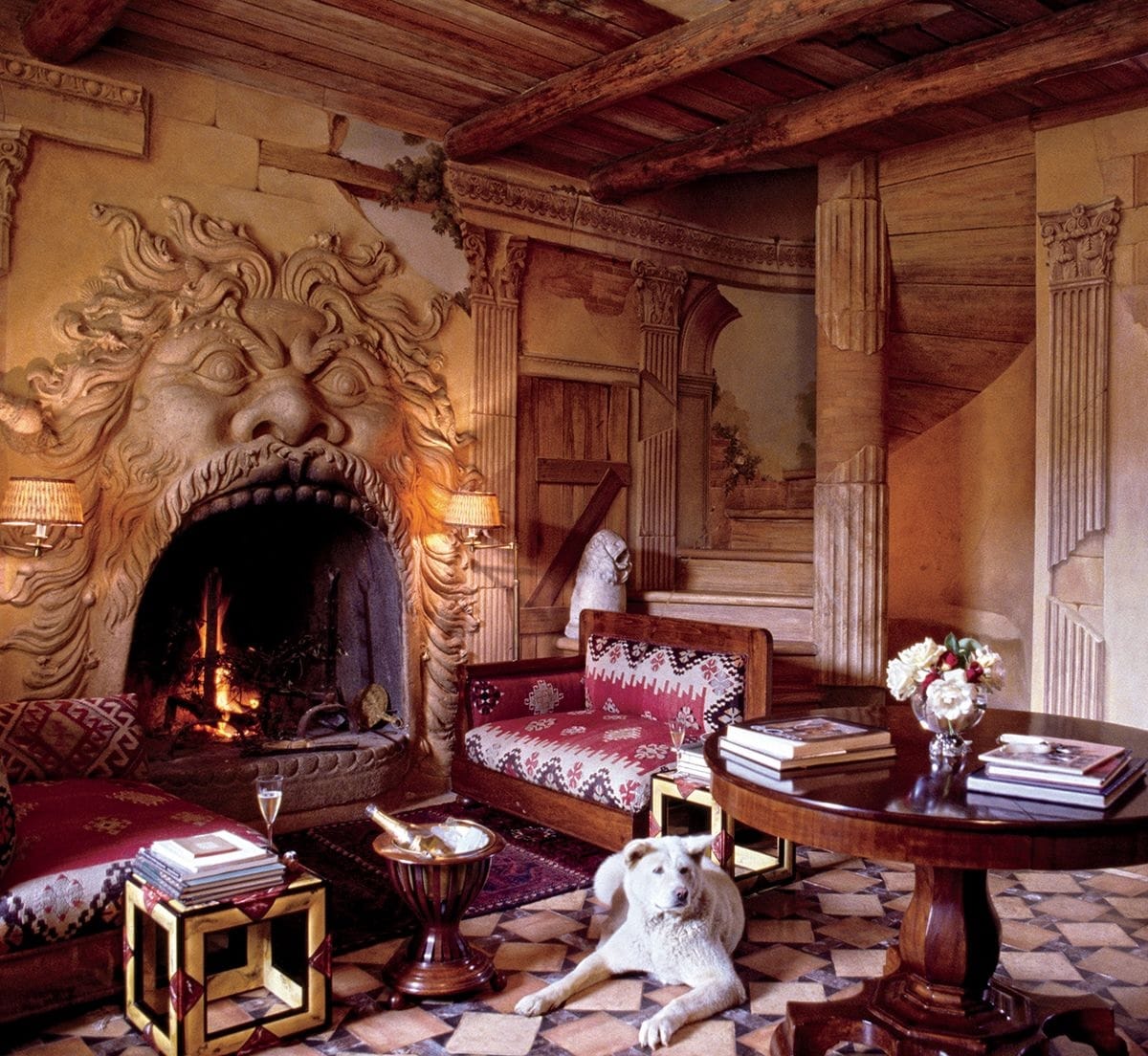
If you're so inclined, please tell me about your favorite childhood (or adult) daydream fodder in the comments and let's dissociate our way through 2026.
It took me a while to get into this book because it uses the same, untraditional format as an older book I haven't read: Gertrude Stein's "The Autobiography of Alice B. Toklas" (1933). Stein's book is written in the voice of Toklas, her longtime partner, and chronicles both Toklas's life, their time together, and Stein's life through Toklas's faux lens. At the start of "The Autobiography of H. Lan Thao Lam," Lin via Lam says this about Stein's work:
In The Autobiography of Alice B. Tokas, Gertrude Stein ventriloquizes her own memoir through the ruse of her lifetime companion's tale of their quarter-of-a-century partnership. Should The Autobiography of H. Lan Thao Lam be published by 2025, it, too, will commemorate a twenty-five-year history, that of H. Lan Thao Lam and Lana Lin. The lives of Alice B. Toklas and Gertrude Stein are remote from mine and Lana Lin's in almost every way except that ours also revolve around the arts. Presumably we share our homosexuality as well, theirs as closeted lesbians and ours as openly gender nonconforming queers.
Lin goes on to point out that if, and I'm paraphrasing, Lam is aligned with anyone in Stein and Toklas's life, it's their Vietnamese cooks who were frequently met with racism and misunderstanding. Lam, we will learn, was born in Vietnam in 1968 during the Tet Offensive. In 1980, their family managed to escape to Canada and Lam stayed there until eventually moving to NYC to be with Lin in the early 2000s. Lin, on the other hand, was born in Canada to Taiwanese parents and moved to NYC in 1988, making her feel "neither authentically Taiwanese nor authentically American." Back to Stein and Toklas, Lin, under the guise of Lam, writes,
I once said to Lana Lin that she had no people, so her people, which she does not have, are not even in the kitchen.
Hopefully this gives you a sense of the dynamic at play. Lin uses Stein's form to explore her own life and the deep love/partnership between her and Lam, both immigrants and only minor footnotes in Stein and Toklas's story. It's sometimes a bit of a mindfuck to parse the various ways Lin uses this level of removal to comment on herself, but you really just need to settle into the flow of her writing and stop overthinking the convention. Here's a snippet I very much relate to:
[Lana Lin] continued to attend high school, which she despised, also wishing she could die, but holding out for an escape from her family and the suburbs, which she considered a desert that couldn't nourish life.
Currently, Lin and Lam are both artists and professors at The New School, but they were after my time. I'd love to run into them someday but I fear they're too intimidatingly cool for me to utter so much as "hello."

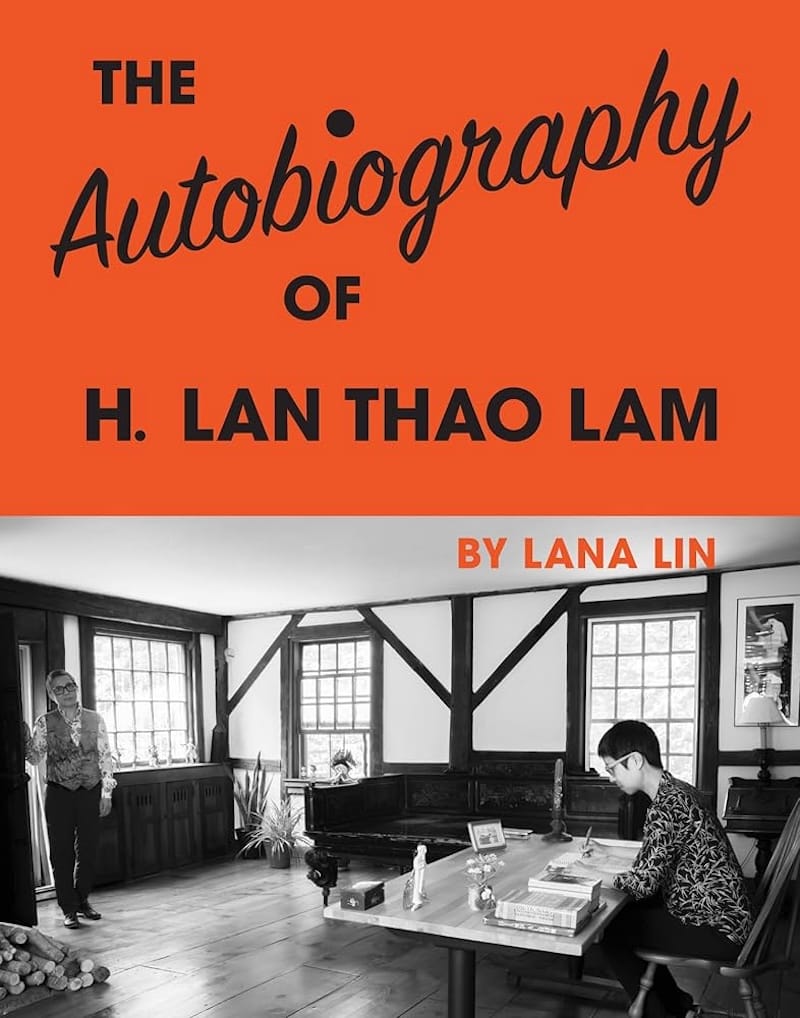
There's an excellent section of the book about Lin's red glasses purchased from Archangel Antiques in the East Village (RIP).
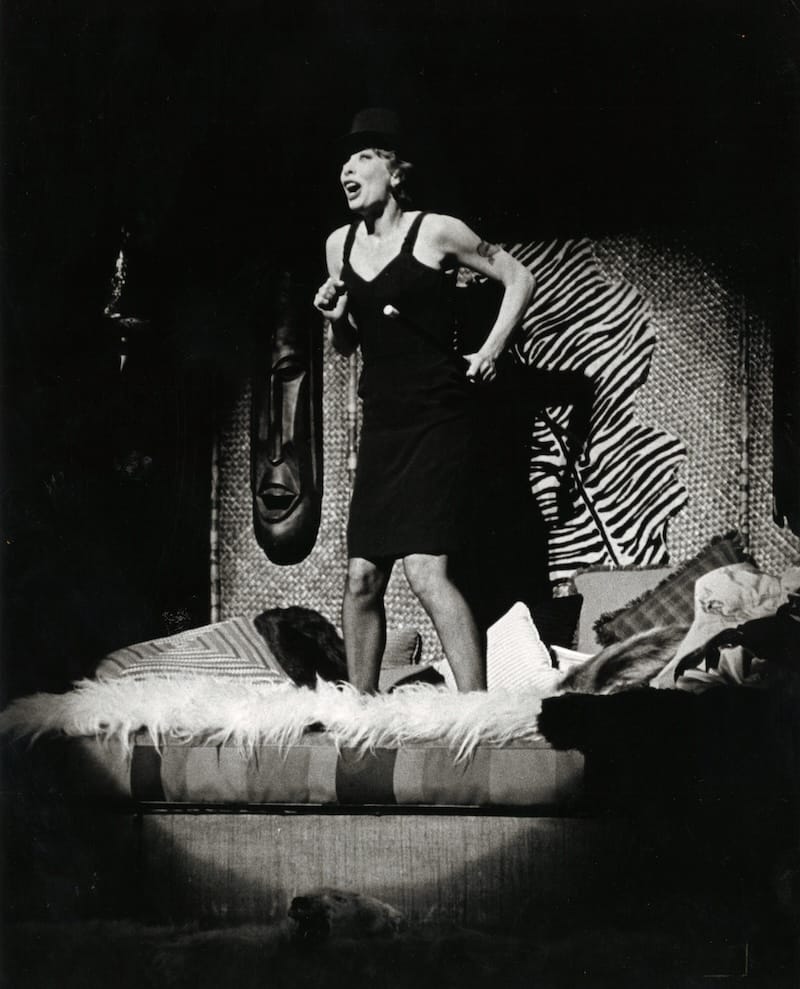
If you've been reading this newsletter for a while, you already know I'm a Fossehead (Verdonhead). This might surprise some people because I don't have the terribly offputting personality of a musical theater fan. At least, not as an adult. If you saw videos of me at age four singing "Hello, Dolly," you'd have a different opinion. Ditto me as a teen blasting "The Last Five Years" soundtrack from my 1989 Oldsmobile Cutlass using one of these bad boys. Adult me doesn't really fuck with musicals, though, unless Bob Fosse and Gwen Verdon are involved. If I had a time machine, I'd go back to 1966 and see "Sweet Charity" on Broadway.
The abbreviated story behind the musical is that David Shaw's ex-wife, Vivian Rosenthal, told Fosse to go see Fellini's "Nights of Cabiria" (1957) when it was playing in repertory at the Bleecker Street Cinema. For those who haven't seen the film, it's about a sex worker named Cabiria (Giulietta Masina) who wants nothing more than to find true love. She thinks she has it, is about to get married, and is ultimately robbed/abandoned by her affianced. Fosse quickly became enamored and screened "Cabiria" for the producing team of Robert Fryer and Lawrence Carr, along with Verdon. Verdon and Fryer found it too sad for a musical comedy, but Carr pushed Fosse to work on an adaptation.
During the process, the protagonist, Fellini's sex worker named Cabiria (Giulietta Masina), turned into Charity, a dance hall hostess. Naturally, Verdon would play her, Fosse would choreograph and direct, Neil Simon got bullied into writing the book, and Cy Coleman agreed to compose the music as long as Dorothy Fields wrote the lyrics. At this point, Verdon's career was at a 6-year standstill, which she had taken after her and Fosse's daughter, Nicole, was born. Charity was a huge comeback role for her and while she was Tony-nominated, she ultimately lost out to Angela Lansbury's Mame. Regardless, Fosse was jealous of how much attention she got for the performance, even though he WON A MOTHERFUCKING TONY for Best Choreography, once grumbling to a friend:
Whose performance do you think she gave anyhow? Do they think a performance comes out of the air? She didn't make it up. A performance has to be directed.
Do you understand the type of man we're dealing with here? When the musical was further adapted into a Hollywood movie, Universal Pictures needed a big star in the titular role, which is how Shirley MacLaine, who had been friends with Fosse since "The Pajama Game," got attached. She wielded her influence to make sure he was hired as the director, giving him his feature film debut. When this all happened, Verdon was a consummate professional, taking on an uncredited assistant choreographer role to help both Fosse and MacLaine. Ultimately, I do love MacLaine in the role, but I can't help thinking about how much bitterness I would have felt from Verdon's position. If there were any justice in this world, we'd all be able to watch Verdon's take on the character, but alas... all that exists are some clips on YouTube, including this one from The Ed Sullivan Show.
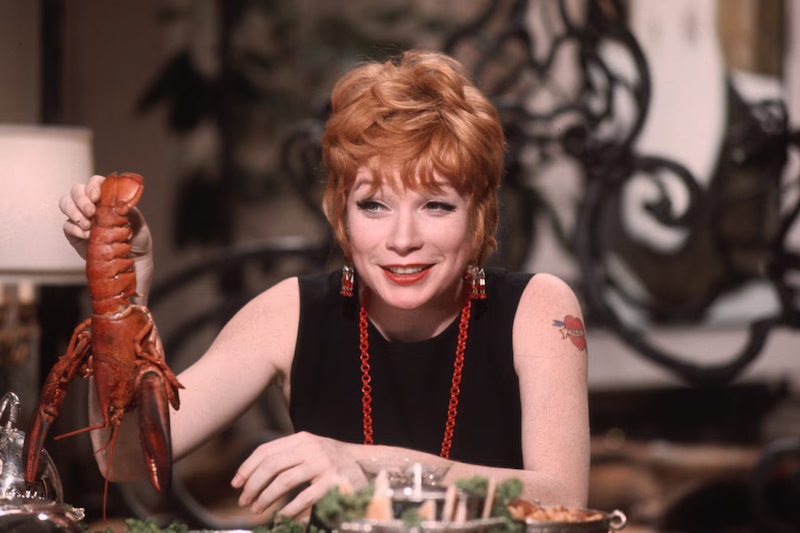
Verdon (left) and MacLaine (right) at Vittorio Vidal's insane apartment.
It's hard for me to even write this because I'm still in the denial stage of grief. One of the weirdest things about the pervasiveness of social media/the internet is opening up Instagram or Reddit to find a feed of tributes, informing you that yet another beloved public figure has shuffled off this mortal coil. In December, it was the Reiners. In October, Diane Keaton. Then, there is the doubly weird experience of someone major like Béla Tarr dying and hearing nothing about it until someone (thanks, Jeffrey) mentions it in conversation. As with the aforementioned people, the news of O'Hara's death initially felt fake. How could this wonderful actor who made crazy, high maintenance delusional narcissists weirdly lovable be dead? She was only 71 and surely had many more roles left in her. What's going to happen to Patty Leigh in S2 of "The Studio"? We finally get a show with Kathryn Hahn and Catherine O'Hara and it only lasts one measly season? This — along with all the rich, evil men who get away with any/every crime — is proof that God doesn't exist.
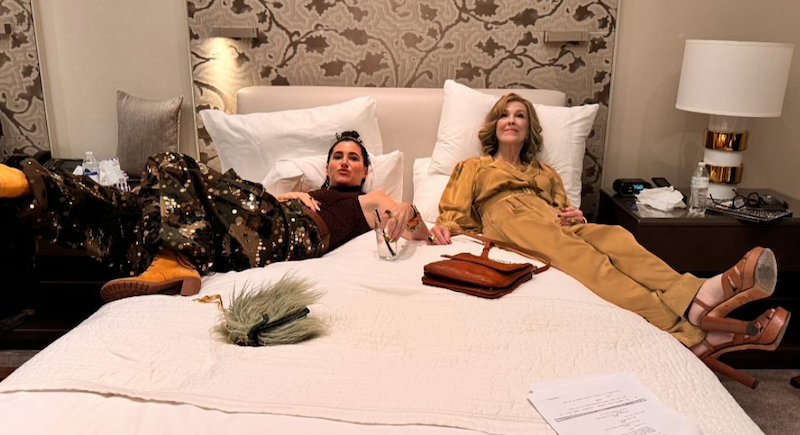
The first time I saw O'Hara on screen must have been in "Home Alone" (1990) and "Home Alone 2: Lost in New York" (1992), which I distinctly remember my Aunt Pat and Uncle Mark owning on VHS. Even as a child, I was perplexed by Kevin's (Macaulay Culkin) parents, Kate (O'Hara) and Peter (John Heard), accidentally leaving their child behind as if he were a mere tube of toothpaste. Yet somehow, you never really blame Kate, as O'Hara plays her with so much frazzled mom guilt and impeccable comedic timing that you're willing to make all kinds of excuses for her dipshittery. On paper, the role is very "generic upper class white lady who still has problems and is trying her best, goddamit!" but O'Hara elevates her to someone you can't easily dismiss because she seems like a good, self-deprecating hang. Kate's a typical parent of that era (neglectful), but at least she knows how much she sucks. She'd never try to spin the McCallister family trips into anything other than the dumpster fire nightmares when she abandoned the same child twice and had to fight tooth and nail to get back to him before he succumbed to death and destruction.
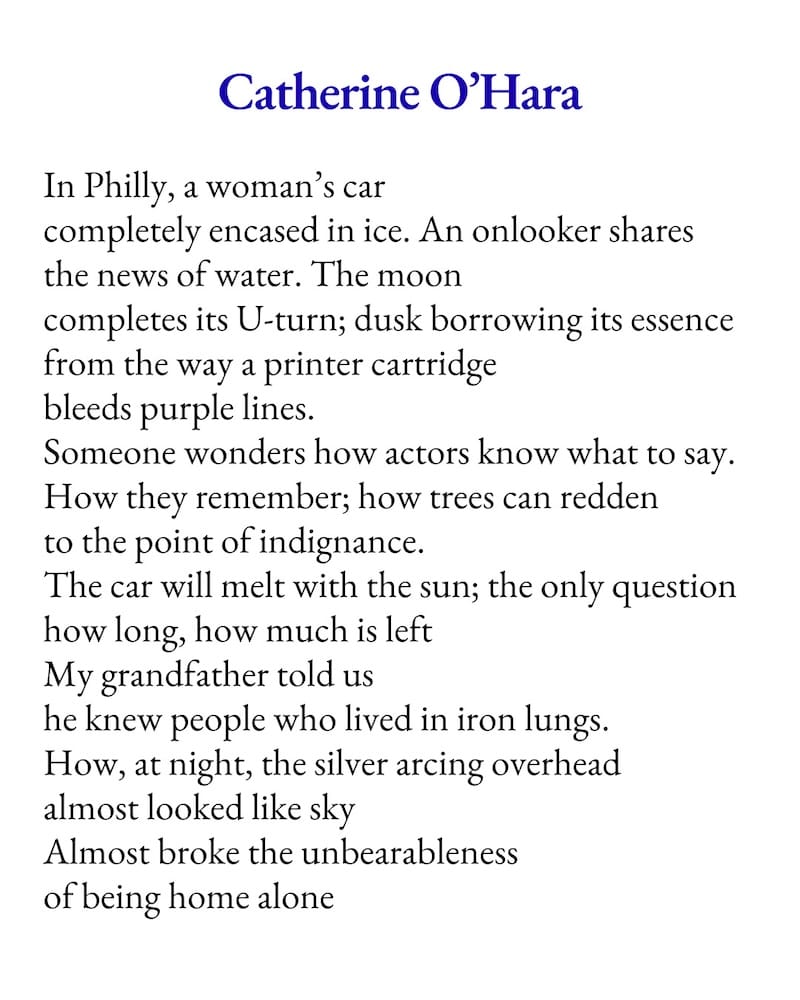
After the "Home Alone" movies, I saw her in Christopher Guest's brilliant films; decked out in Japanese fashion in "Beetlejuice"; as the voice of several iconic characters; and, thanks to YouTube, in many SCTV skits. I never would have gotten through the pandemic without Moira Rose and her little bébé crows/wig wall. I leave you with this poem from Meggie Royer and deep sadness in my heart:
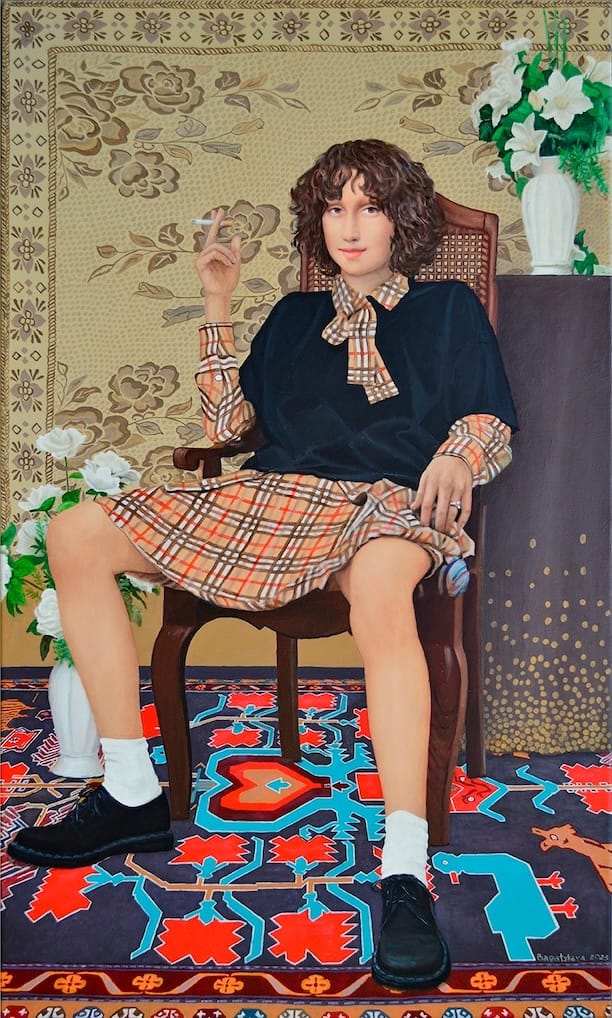
Selfishly, I almost don't want to tell you about Nataliya Bagatskaya because I aspire to own one of her paintings someday and I'll cry if one of you bastards swoops on "The Return of the Prodigal Son." There's not much information about her on the internet, so what I know is pretty basic and likely from weirdly translated sources and/or possibly garbage AI:
- She's in her late 50s/early 60s and lives in Kyiv, Ukraine.
- Her style is varied, but the pieces I like most blend pop art, realism, and conceptual elements.
- Cats feature prominently in many of her paintings, along with the Mona Lisa's face.
- She has a fashion design background.
Some of her work reminds me of this Larry Steinrock painting:
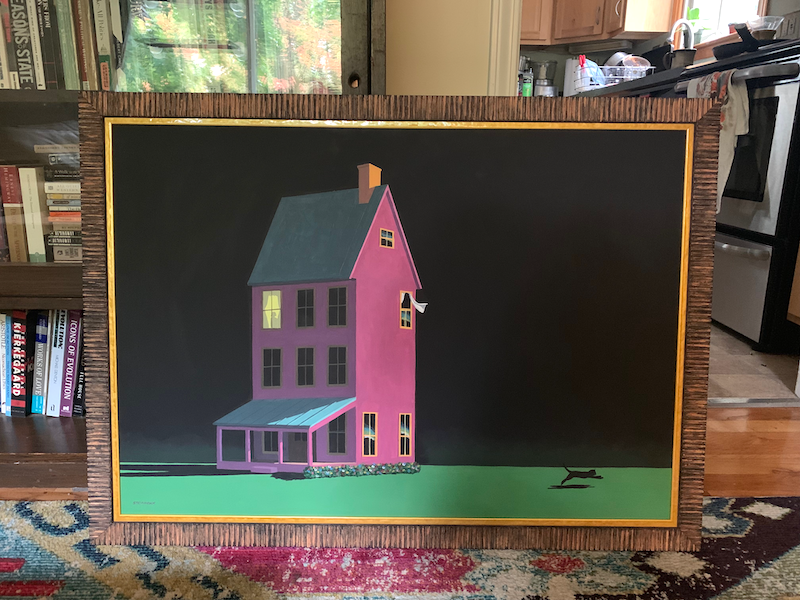
I like to imagine that the cat running away above is embroiled in a "Six-Dinner Sid" situation. He showed up at the pink house above, ate dinner #1, skedaddled, then showed up at the white house below, where the person holding him fed him dinner #2. Bottom right is dinner #3. The number of friends/lovers who show up with him at each house reflect his status and, as you'll clearly see, he is held in greatest esteem at the third house, where he is so worshipped that a painting of his likeness (with halo) hangs in a spot of prominence.
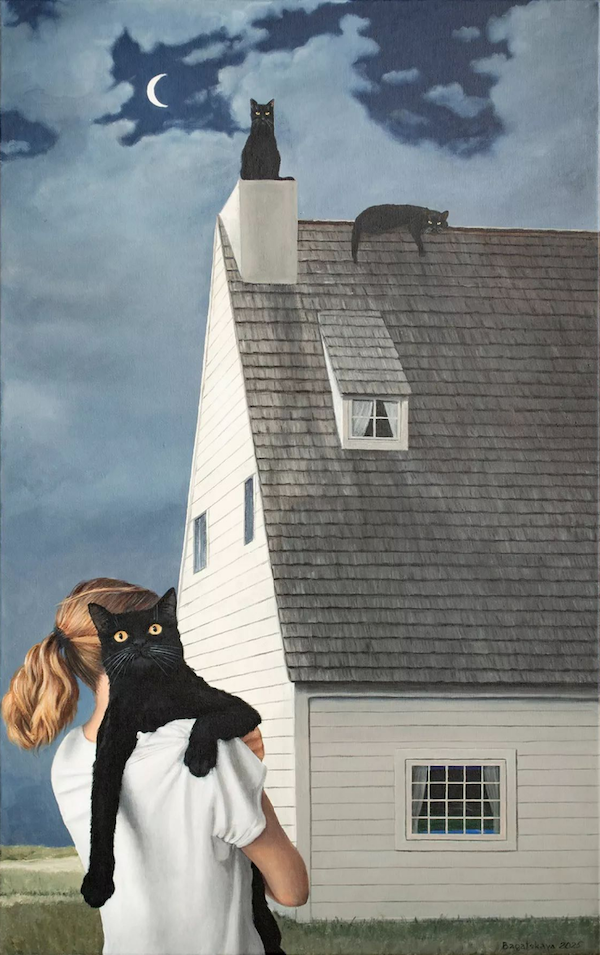
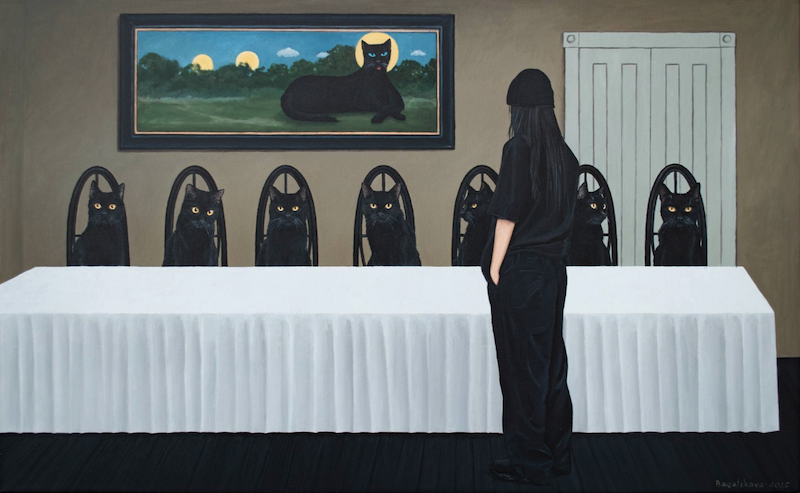
Left: "The Prodigal Son Returns." Right: "Snow White and the Seven Dwarfs."
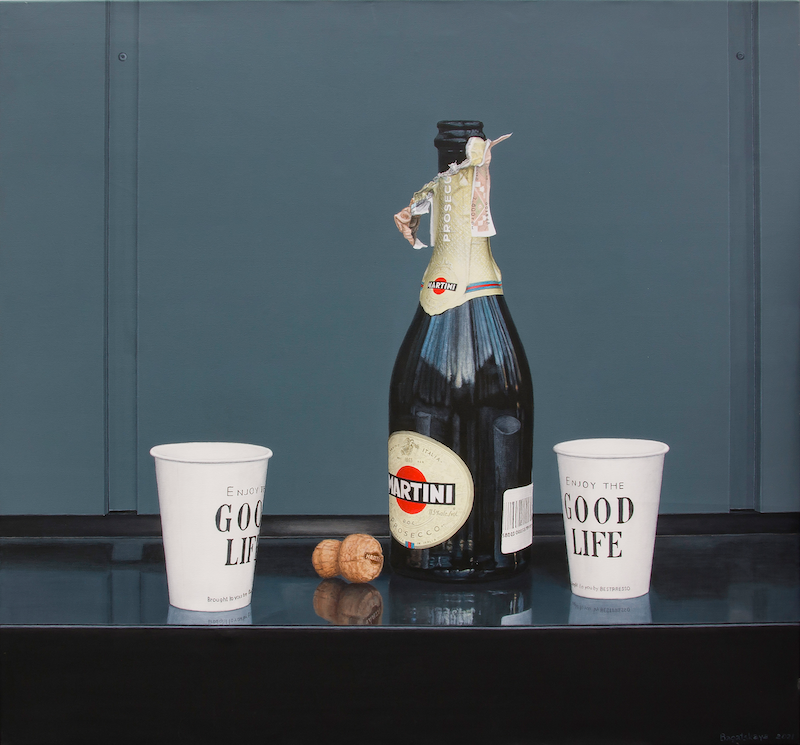
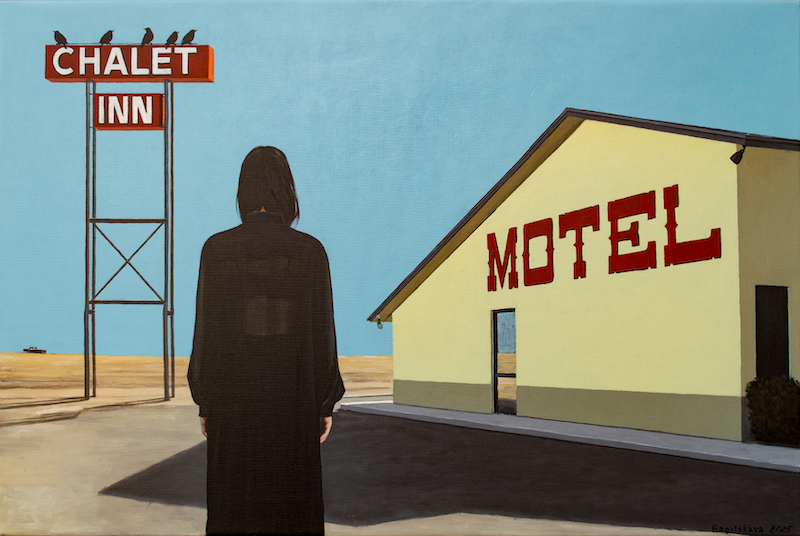
Bagatskaya also does some hyperrealist paintings which I must admit that I don't like nearly as much even though they involve a great deal of skill. I appreciate them, I just don't want one hanging on my wall nearly half as much as "I'm Waiting for You":
Here are two poems in honor of Black History Month, which Pedophile Trump is celebrating by tweeting his standard racist garbage:
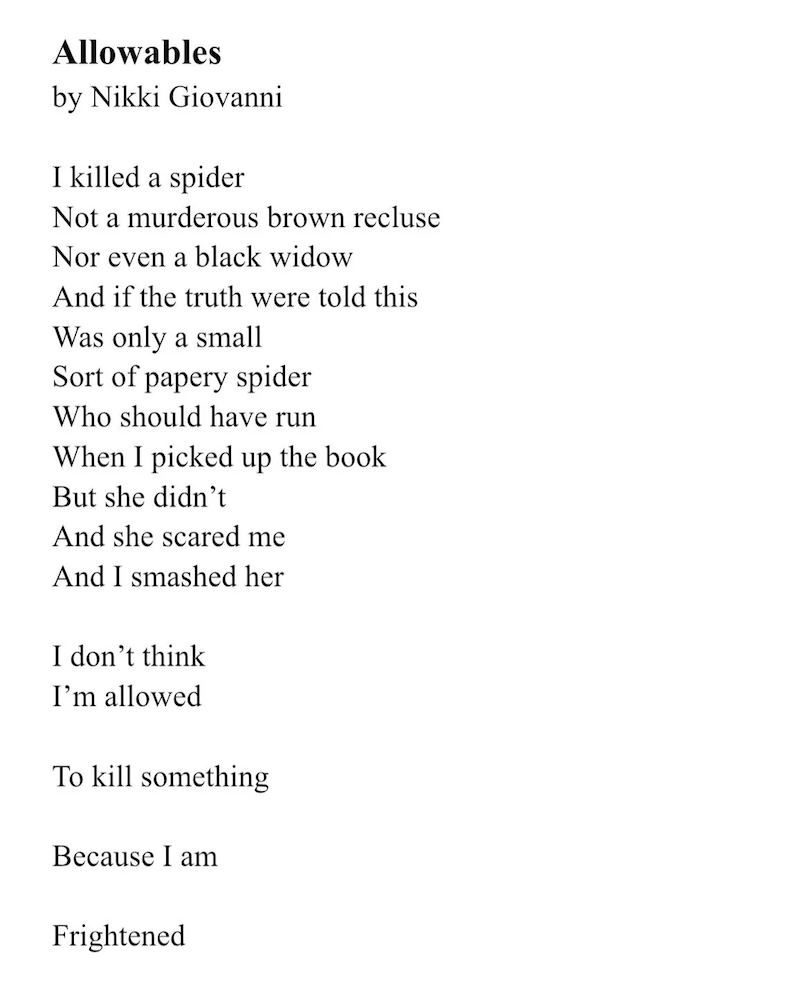
In a 2017 interview with American Libraries, Giovanni was asked why she thinks this poem, published in 1968, had been trending on social media. She said,
I don’t do social media. I don’t know how Trump does that thing, Twit. I don’t know where he gets the time. But I have been amazed that this poem has been embraced the way that it has. You don’t have the right to kill something because it might frighten you. All of us are hurting people we shouldn’t. I’m living in Appalachia, and a lot of people are upset with the coyotes. Well, you’re not allowed to shoot the coyotes just because you think that they might eat your sheep. They can’t get a driver’s license and go to McDonald’s; they have to eat something.
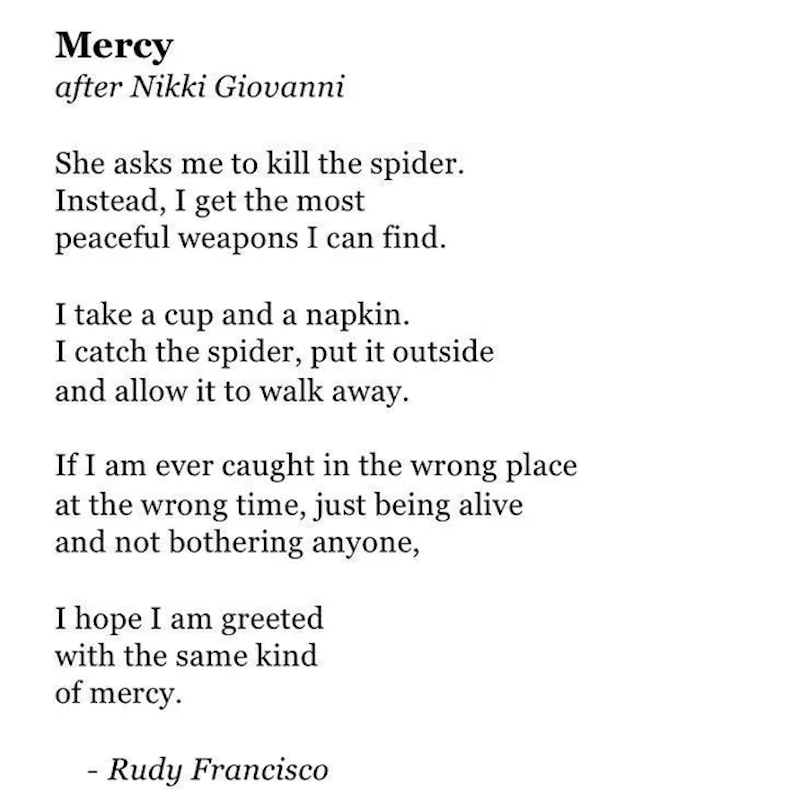
In response to Giovanni's poem, Rudy Francisco wrote his own, published in 2017:
Unfortunately, I can't find a video of Giovanni reading "Allowables," or I would have included it.
How much better would our lives be if the people in power were artists, poets, women, LGBTQIA+, people of color... basically anyone but evil, soulless, white male billionaire fucks, the killers of spiders and everything that is good/right/holy?
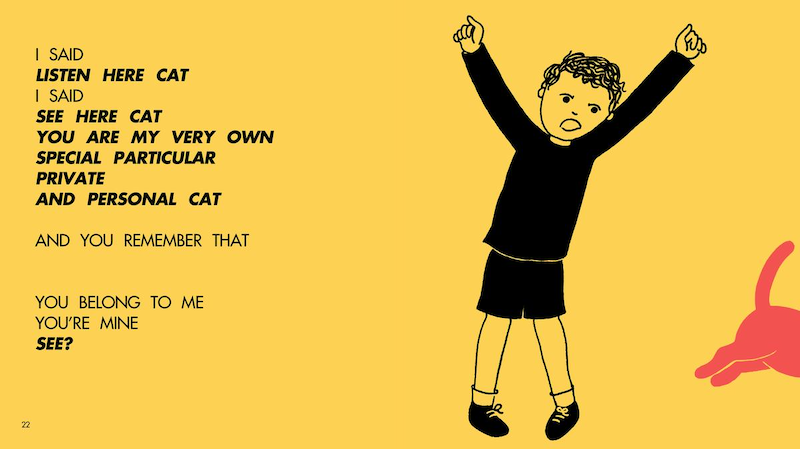
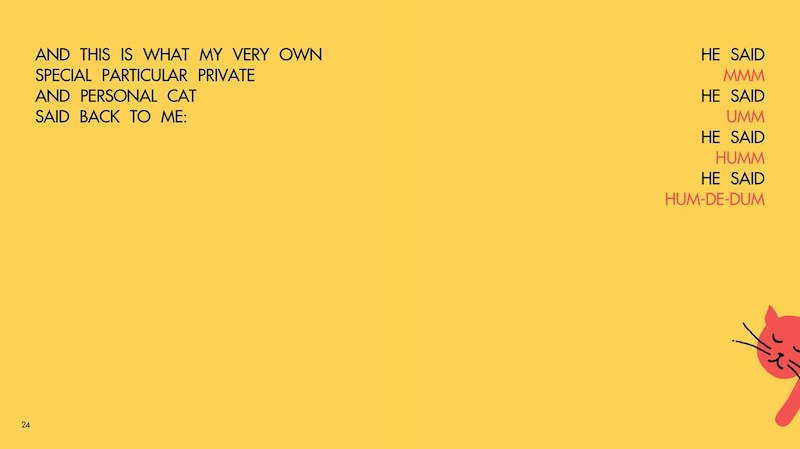
I bid you farewell with Remy Charlip's illustration from "My Very Own Special Particular Private and Personal Cat" (1963), a book about a little boy who learns some very important lessons about boundaries from his bff with one orange brain cell:
P.S. My friend's six-year-old is very into Fleetwood Mac. Is it too early for me to give him an abbreviated version of the lore? If not now, when?