

Nina Menkes is one of those filmmakers you'll either love or hate depending on your level of patience and penchant for bleak, plotless imagery. She makes independent, experimental low-budget films that exist far outside the mainstream. Even during the indie film boom of the '90s, she flew far under the radar and struggled to find funding for her next project. In an interview with Film Comment, she says,
All my films, made on minuscule budgets that rarely contained even one cent of salary, exist today due to my intense, driven need to make my movies come hell or high water and at any cost, except compromise. While I watched male colleagues make acclaimed first works and then get significant money for their second, third, and fourth features, this is something that almost never happened—and still rarely happens—to women directors.
As much as this financial lack sucks, it has resulted in an incomparable body of work that shirks convention, legitimately challenges audiences, and doesn't seem to give a fuck about how it's perceived. More often than not, the emotion I'm left with after watching Menkes's work is anger. Women in her films are alienated, brutalized, objectified, and exploited; unlike in real life, there aren't many opportunities to look away. Menkes forces attention by holding shots for extended periods of time and repeating them, waterboarding the viewer with a steady drip of patriarchal oppression. It's disconcertingly effective, like being placed under a paralytic spell for 80 minutes.
This Saturday (5/2), Metrograph is screening two fims — "Queen of Diamonds" (1991) and "The Bloody Child" (1996) — followed by Q&As with Menkes. NYC people: make like everyone's favorite bandit cinephile and go check them out. Non-NYC people: stream them, along with "The Great Sadness of Zohara" (1983) and "Magdalena Viraga" (1987), via Metrograph At Home (for the crisp 4k restorations) or Kanopy (if you're ok with a lo-fi experience). If you've seen "Dissolution" (2010), Menkes's take on "Crime and Punishment," and want my thoughts on it, too, here is a 2016 relic.
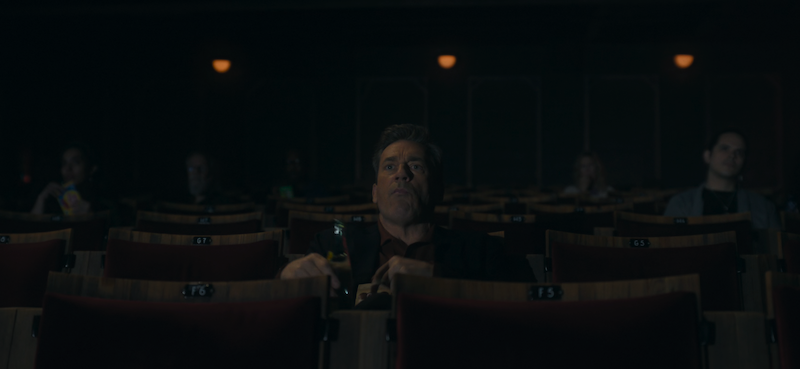
Menkes's work has been compared to David Lynch, Andrei Tarkovsky, and Chantal Akerman. If you like any of those filmmakers, she's worth exploring. If, by chance, your first introduction was her 2022 documentary, "Brainwashed: Sex-Camera-Power," you should know that her earlier films are much different and still worthwhile even if you hated that one. If you need more convincing or you've already seen the films, read my thoughts below.
🌴 "Queen of Diamonds"
Of the two films screening at Metrograph, "Queen of Diamonds" is my favorite. It follows a blackjack dealer named Firdaus (Tinka Menkes, Nina's sister/collaborator) who works at Bob Stupak’s Vegas World Hotel and Casino. When she's not stuck in perpetual, neon midnight, she takes care of an elderly man in a motel room, hangs out with her friend (Emmellda Beech), and half-heartedly searches for her missing husband. The film moves from dark, artificially lit interiors to the blazing heat of the desert.
Nothing particularly awful happens to Firdaus, but there is the perpetual sense that we're watching her long, slow march toward death. At no point does she seem like an active participant in her life, more like a voiceless specter who's there until she isn't. Her only vociferous moment occurs in a dreamlike sequence when her neighbor screams at her friend to shut up and Firdaus, splayed on a couch with her hand over her face, screams back, "You shut up! Don't you think we're tired of hearing you beating up your girlfriend?" Later in the film, Firdaus attends the wedding of this abuser and his victim, floating around the guests, including an Elvis impersonator, who are all dressed in white and drinking champagne. When she exits, two women sitting on the ground, sharing a joint, ask if she liked the wedding and she nonchalantly replies, "Not really."A few scenes later, she waits in the dark on a crowded roadway, accepts a ride from an offering stranger, and disappears as the tail lights fade into the distance. She's there, then she's gone, and what happens in between? Work and death... the soullessness of existence.
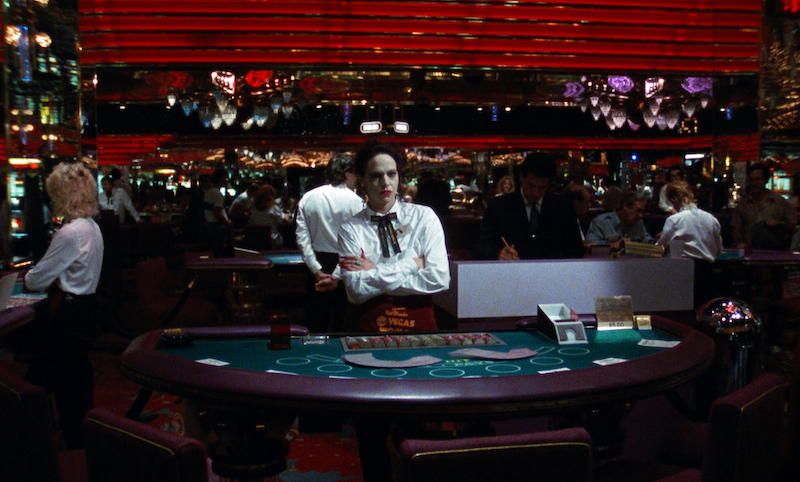
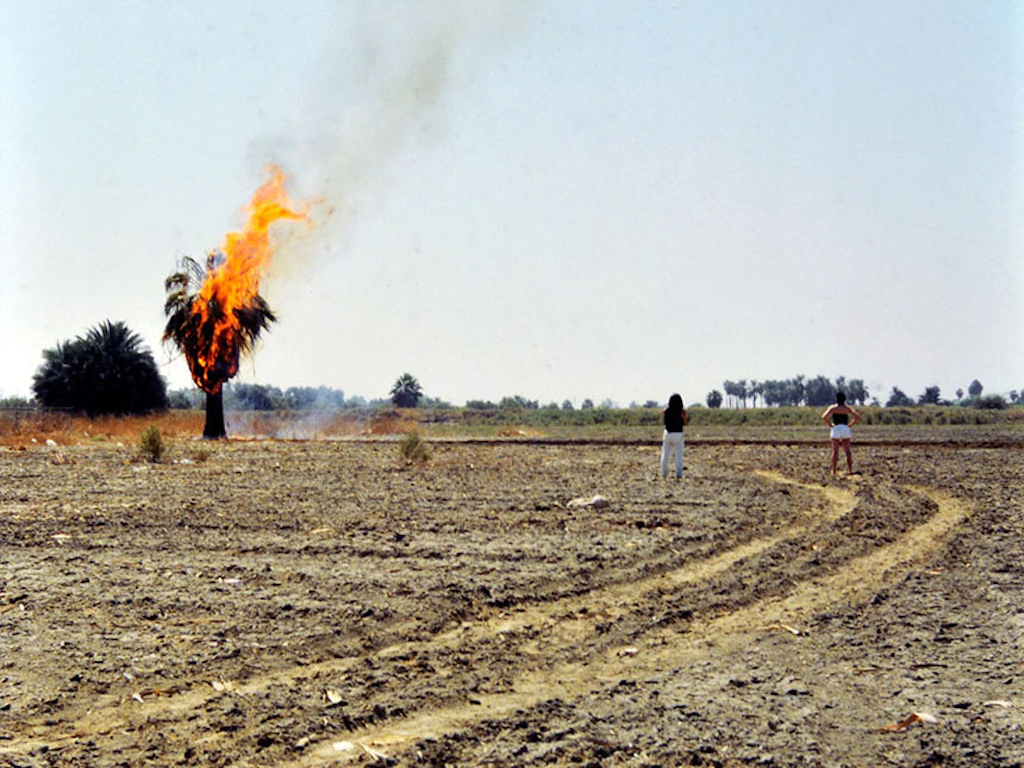
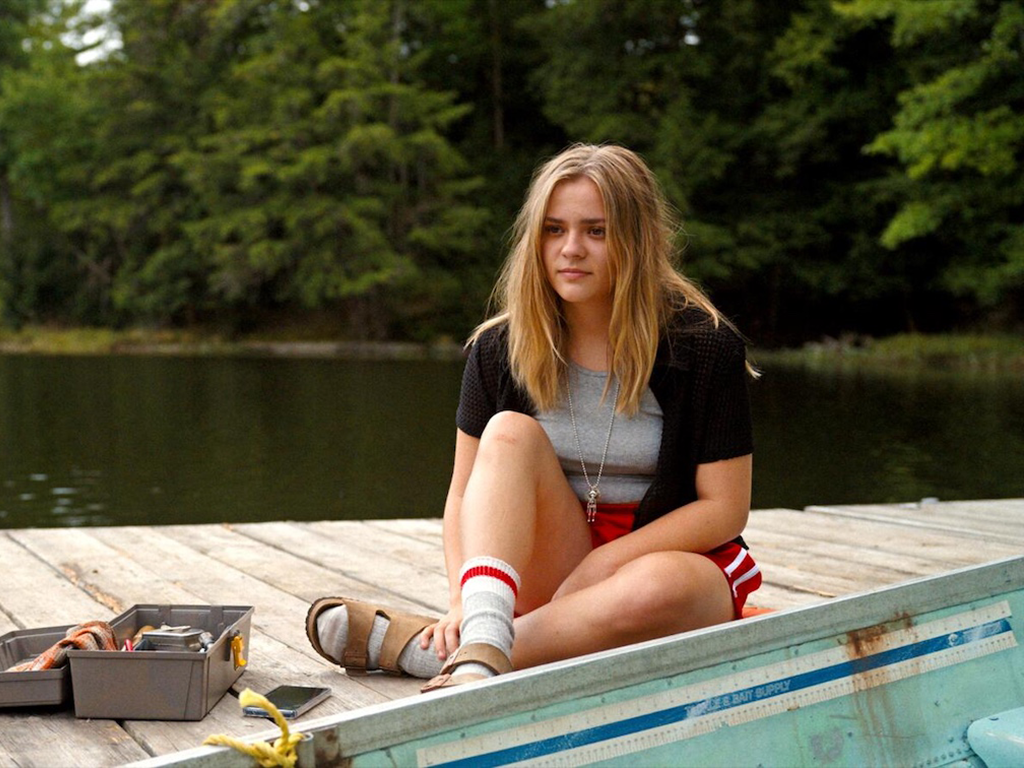
This film works well for me because the premise and intention are minimal, but executed with cohesive, well-composed visuals and clever editing. I love the 17-minute-long sequence where Firdaus deals blackjack, blankly doling out cards, collecting chips, and pushing cash through the money slot. It's like watching a choreographed ode to disgusting American capitalism where everyone is unhappy, yet powerless to stop. There's another long scene, featured as the header image of this post, where she meets a man by the lake, then accompanies him to the middle of the desert where they stand in silence, watching a palm tree burn. Eventually, he wordlessly exits the frame as she remains, transfixed. Firdaus's body posture is typically closed off with her shoulders hunched over, arms crossed over her chest, or arms covering her face. As the palm tree burns, she stands in something of a power pose with legs wide and hands on hips. It's the same stance she adopts when she's outside in the middle of the night and looks down at a dead cat decomposing in the mud. Life is full of shame, of things you must do (but don't want to) that suck all the joy out of existence; maybe death is better.
Watch if you like: John Gregory Dunne's Vegas memoir, cats, the seedy underbelly of tourist attractions, extras ripped straight from Diane Arbus photos, monotony.
🪖 "The Bloody Child"
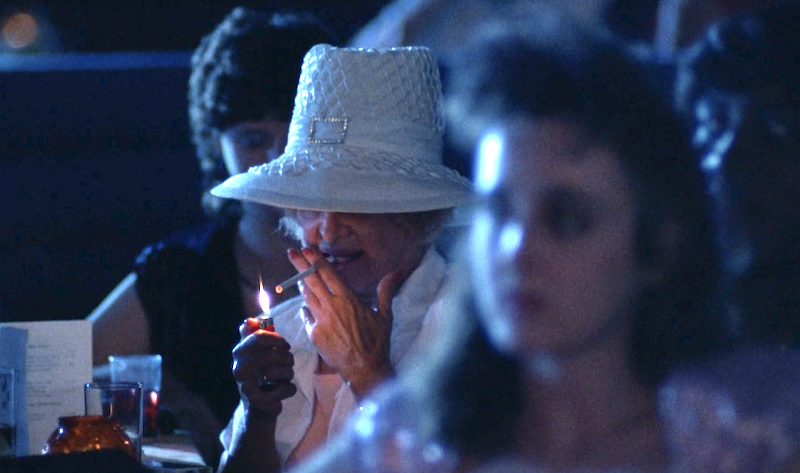
Ripped straight from the headlines and tossed into a meat grinder, "The Bloody Child" is about a Gulf War veteran who murders his wife and is caught digging her grave in the Mojave Desert. In typical Menkes fashion, it's told non-linearly with flashes back and forward in time, along with more metaphysical pieces that transcend time altogether. As with "Queen of Diamonds," Tinka Menkes stars and is also credited as Nina's co-editor. In this film, she plays a Marine captain whose authority is constantly undermined by her subordinates. One of the repeating sequences includes several marines waiting in the desert for backup at the scene of the crime with the murderer and his victim contained in separated cars. They mill around, speculating about his motivation, which of course includes the idea that perhaps she was cheating on him (and thus, deserved it).
In the hardest to watch repetition, one of the marines forces the murderer into the backseat with his wife, shoving his face into her bloodied body while screaming things like, "Do you fucking like that?" Violence is met with faux superior violence, as if desecrating this woman's corpse to make her murderer husband feel (sexually-tinged) shame is somehow not also deeply disrespectful. Another repeated scene that's often intercut with this one includes a bunch of marines at a cowboy bar, dancing suggestively for women but performing just as much for each other. It's unadulterated, stereotypical masculinity on display in public, juxtaposed with femininity in private. One of the marines is sleeping with the captain and there's a great scene where he wakes up in her floral apartment, then takes a bubble bath while telling her about his dream.
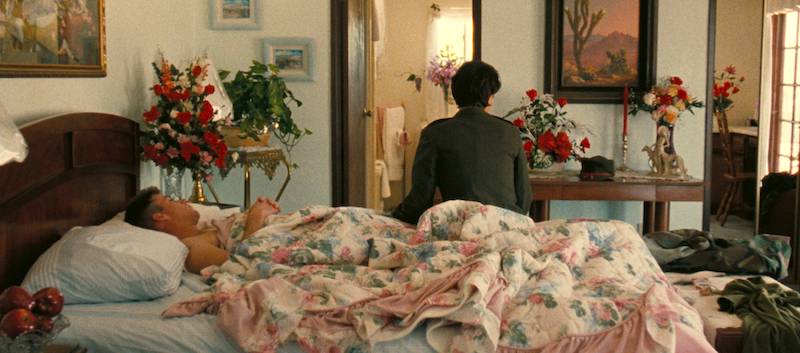
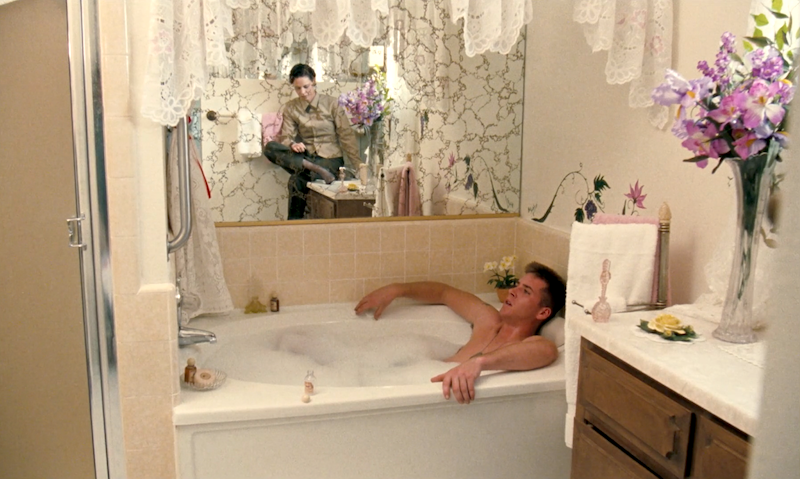
The dream description is so long and she somehow looks moderately intrigued.
The scenes that gave me pause and prevented me from connecting with this movie were shot in northeast Africa, although the only clue I noted while watching was some graves marked in Arabic. In one, a woman (Tinka) painted to look like a statue lies in the forest and occasionally carves things into her arms. In another, unnamed people — one played by Tinka, the other a Black man (and then later, a Black boy) — lounge around with pained expressions. In an interview I found with Menkes, she talks about shooting this footage in Africa a long time ago and liking it but feeling like it wasn't a complete film. She decided to include it in "The Bloody Child" as "the underside of that female marine--this wounded inner feminine." To me, it reads more like something she wanted to include and justified after the fact because it felt disconnected from everything else and I found myself fixating on to the point of distraction. Gripes aside, I still recommend watching for anyone interested in Menkes's filmography.
Watch if you like: the horror of heteronormative bullshit, horses (s/o Saunder and Miles), watching the sky change colors, swimming in an empty pool, Shakespeare's "Macbeth" (I actually hate this element of the film).
Member comments